











Anyone who has been to the moon (who hasn’t?) knows that the sticky dust that coats the moon’s surface can damage spacesuits. A spray of liquid nitrogen may provide the best way to remove objects without damaging the suit, according to new research.
Lunar dust, scientifically known as lunar regolith, is unlike most natural dust on Earth.
First of all, it is not subject to wind or water erosion, so the fine grains are very jagged and abrasive. In addition, regolith is saturated with solar radiation, so it has a positive charge and therefore sticks to anything it comes in contact with.
On the Apollo lunar missions, astronauts found brushes to be completely ineffective at removing regolith from spacesuits. In fact, brushing only ground the dust. Parts of the suit were actually rendered unusable after Regolith damaged the seal.
Not to mention particles are also not suitable for electronics or engines. Some astronauts developed respiratory problems that persisted after returning to Earth.
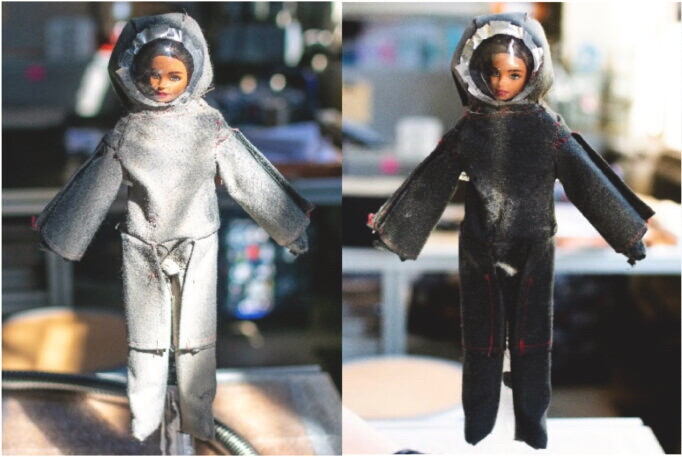
Scientists at Washington State University recently turned to liquid nitrogen for a more effective and less harmful alternative to brushing and other proposed regolith removal methods.
Applying a liquid cryogenic spray to a warmer sample of simulated regolith-covered spacesuit material caused dust particles to bead up and float in the nitrogen vapor. This reaction was due to what is known as the Leidenfrost effect, in which droplets of liquid are suspended above the surface by a layer of vapor. This is what cold water does as it beads up and traverses the surface of a hot skillet.
Washington State University
The technology was tested both in normal atmospheric conditions and in a vacuum similar to outer space. It worked in both, but performed better in vacuum, removing his 98.4% of dust particles.
In addition, a single brushing of the dust-covered material sample caused damage, but no damage was observed after 75 repeated liquid nitrogen treatments.
Scientists now plan to conduct further tests under conditions that more closely simulate lunar conditions. A paper on their research led by Assoc.Professor Jacob Leachman – recently published in the journal Acta Astronautica.
Source: Washington State University
