











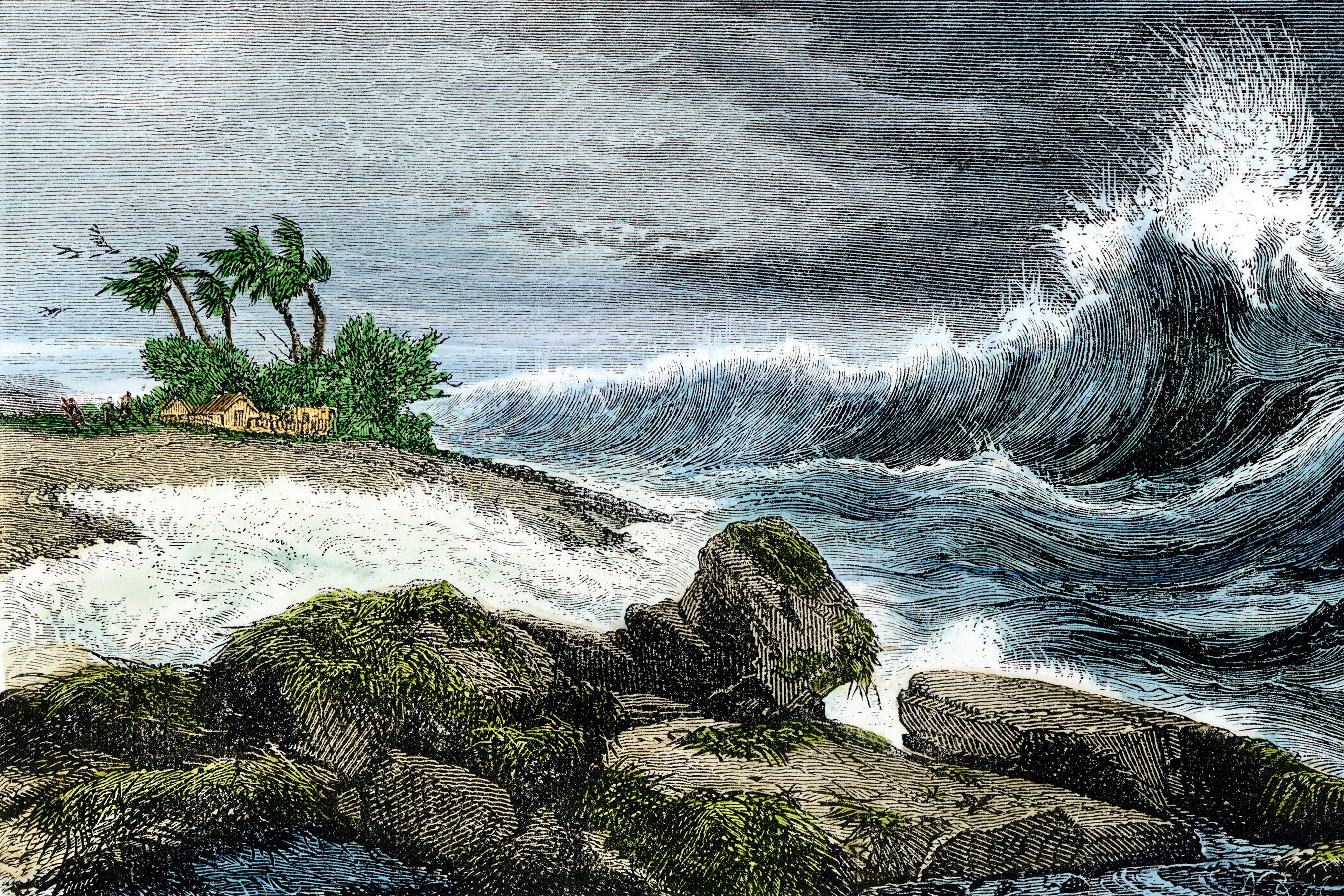
Rocks weighing over 40 tons rise above the sands of the sea. It dwarfs all other rocks in sight and is clearly out of place. The answer to how this giant outlier got here lies not in the vast Atacama Desert behind it, but in the Pacific Ocean below. Hundreds of years ago, a tsunami slammed into the northern coast of Chile. The 20-meter-high wall of water was taller than a six-story building, and rocks were swept toward land like pebbles.
The tsunami that struck this behemoth occurred before Chile was recorded. But we know about it today, thanks to the work of a small group of researchers uncovering signs of ancient tsunamis around the world. Tsunami researchers have found evidence of a previously undocumented gigantic wave. In the process, their research reveals that coastal areas could be far more endangered by tsunamis than they realize.
James Gough, a paleotsunami researcher at the University of Southampton, UK, says as scientists expand their search, they continue to find ancient tsunamis larger than those seen in the historical record. . The meaning is clear. If a huge tsunami hits him once in a particular place, it can happen again. The question is, are you ready for it?
A tsunami is not just a big wave. Conventional waves, even if they are tens of meters high, are usually caused by the wind and involve only the top layer of water. They carry relatively little energy and usually hit the shore harmlessly.
Tsunamis, by contrast, are caused by geological forces such as earthquakes, volcanic eruptions, or mountainsides crashing into the sea. A tsunami engulfs the entire water column. Massive tsunamis can reach heights of 20 meters or more, but the most massive ones can rise hundreds of meters, but they don’t need to be particularly tall to cause widespread damage. Instead of collapsing on the beach, the tsunami hits the shore like a battering ram. After running more than a few hundred meters inland, the water recedes into the depths, carrying away almost all of its path. However, tsunamis almost always leave traces of their passage. It’s like an out-of-place rock high in the desert.
Gough has been looking for ancient tsunamis for almost 30 years, mostly in countries bordering the Pacific Ocean. He is one of the few scientists in the world who specializes in finding paleotsunami evidence.
The easiest way to know when a tsunami struck hundreds or thousands of years ago is to look underground, says Gough. As the wave recedes, it leaves behind all the imprints it contained scattered across the surface. This thin layer of silt, rocks, tiny shells, and other marine sediment fills up over time, keeping the tsunami’s path between the layers of sediment. In some places, the strata are so well preserved that researchers can see evidence of multiple tsunamis layered together like strata cakes.
Excavations in Maui, Hawaii show four bands of tsunami deposits. Scientists have yet to guess when these tsunamis occurred.Photo by Scott Fisher
In southern Chile, burrows and bands can be counted near many coastal rivers. “One, two, three, four,” says Goff. “And just by looking at these layers, you can tell they’re paleotsunami.”
Paleotsunami signatures can be difficult to discern in locations with rocky or barren terrain, and the techniques used must be tailored to the environment. Goff and others are looking for microscopic marine organisms such as diatoms and foraminifera, ancient DNA in marine organisms, changes in geochemistry, and even unexpected rocks like the Atacama.
The Atacama tsunami likely occurred in 1420, says Tatiana Izquierdo, a paleotsunami researcher based at Spain’s Rey Juan Carlos University, who helped find it. She and her colleagues dug under rocks to find undisturbed deposits. They radiocarbon dated some of the shells they found, giving a possible range from the 14th century to her 16th century. Upon further investigation, the team found that the historical record of a tsunami that occurred in Japan in 1420 matched that date. Izquierdo said their tsunami likely originated off the coast of Chile after a major earthquake and crossed the Pacific Ocean to reach Japan.
In other cases, paleotsunami researchers drew insights from the archaeological record. Chilean archaeologists had previously noted that about 3,800 years ago, many coastal sites were suddenly and systematically abandoned, and new sites quickly emerged inland, Izquierdo said. Additional evidence, such as shell mounds showing evidence of erosion by strong currents, hinted at the possibility of a paleotsunami.
These dates are perfectly consistent with the giant paleotsunami, in which Gough found evidence of the distant New Zealand ocean. In New Zealand, a rock the size of a car was thrown almost a kilometer inland. It’s a disaster that doesn’t appear in the historical record, according to Goff, a tsunami that likely affected islands across the South Pacific, including Vanuatu, Tonga and the Cook Islands. We do not yet know the full extent of the destruction it has caused, as we have not yet sought corroborating evidence on these islands.
Knowing how big and how bad the paleotsunami was is of more than historical interest. That data is of great value to modern coastal communities.
Tsunamis are impossible to predict. At best, residents receive minutes to hours of warning from agencies like the National Tsunami Warning Centers in the United States and Canada, which use buoys and seismometers to detect potential tsunamis before they reach land. There may be. The resulting alerts are based on computer models fed with data on historical tsunami behavior. Warnings may not be entirely accurate if important events that do not appear in the historical record are overlooked, as paleotsunami researchers are steadily revealing.
Goff cites the 2011 Great East Japan Earthquake as a classic example of the dangers of ignoring evidence of past events.
The 2011 tsunami was generated by a magnitude 9.0 earthquake on the ocean floor off the coast of Japan, generating waves up to 40 meters high and traveling 10 kilometers inland. The water overwhelmed the seawalls and flooded more than 100 designated tsunami evacuation sites. It destroyed entire towns and crippled the Fukushima Daiichi nuclear power plant. Over 15,000 people died.
Part of the problem was Japan’s inadequate defenses. Researchers know from historical records dating back to the 17th century that he knew of three large tsunamis, one of which he generated waves about the same height as the 2011 tsunami. However, authorities have based their tsunami preparedness, including building breakwaters and setting up tsunami evacuation zones, on the tsunami generated by the 1960 Chilean coastal earthquake, which caused waves as high as 6 meters in Japan. has occurred.
“We knew how big they would grow [in Japan]We knew that these must have occurred in the waters near Japan. Yet we were completely unprepared,” Goff says.
The 2011 Tohoku tsunami was the most devastating of modern times. But it wasn’t unprecedented, as paleotsunami studies have shown.
Back in Chile, Izquierdo is particularly worried about what would happen if a tsunami as large as the one that threw rocks into the Atacama Desert today came. , people built houses very close to the beach. Those homes could be in serious danger if a tsunami hits.
Paleotsunami researchers reveal that tsunamis we don’t know are often more devastating than those we know. and you may not see waves this big in those places anytime soon. But somewhere, someday, it will.
This story originally appeared same magazine and is part of cover the climate nowa global journalistic collaboration to enhance coverage of climate articles.
