











As a nascent planet, Jupiter shone brightly in the sky, outshone the Sun today from the perspective of the gas giant’s largest satellite. Its early brilliance and future visits by multiple spacecraft may help solve a 40-year-old mystery about the composition of these moons.
For decades, scientists have struggled to make sense of the strange density differences among Jupiter’s four Galilean moons. Jupiter’s closest to furthest moons are Io, Europa, Ganymede, and Callisto. These natural satellites should have formed from the same raw materials and have similar compositions, but densitometry shows that Callisto and Ganymede are much more icy than Europa, while Io has no ice at all. is suggested. New research revealed at a conference last month by Carver Bearson, a planetary scientist at Arizona State University, may shed some light on the issue.
Giant planets are formed by the compaction of huge amounts of gas and dust. This process releases a large amount of excess energy, giving the newborn giant a literal youthful glow that will last for millions of years. Astronomers regularly use this glow to photograph young giant exoplanets that are lost in the glare of nearby stars. But the less obtrusive question of how moons with such glows form remains largely unstudied. In the case of Jupiter, computer modeling by Bearson and his colleagues suggests that the planet’s early glow illuminated its nascent moons and would have boiled most of the water within millions of years. .
“It gives people a whole new way of thinking,” says Francis Nimmo, who studies icy moons at the University of California, Santa Cruz, but was not involved in the study.
4 satellites, 1 origin
The different compositions of the four Galilean satellites have puzzled researchers for decades since the satellites’ first high-quality density measurements were obtained. Trapped within Jupiter’s radiation belts and internally heated by the planet’s powerful tidal forces that knead the Moon’s interior like dough, Io is a completely ice-free superactive volcanic world. A little further away, Europa is also affected by Jupiter’s radiation and tides. But a more moderate level of internal heating causes the Moon to form an underground ocean and ice crust rather than a lava-spouting caldera. Both Ganymede and Callisto are relatively inert, ice-rich, and farther from Jupiter than Io and Europa.
While it’s clear that differences in Jupiter’s gravitational grip are responsible for the differences in the moons, planetary scientists have wondered why these bodies are so dramatically different from each other despite sharing a common origin. I’m still having trouble understanding the Similar to how planets emerge from a swirling protoplanetary disk of gas and dust around a nascent protostar, large moons are formed from tiny little disks that form around assembling giant worlds of gas. may occur. Current thinking is that Jupiter gains most of its mass very rapidly within the first 10 million years of the solar system’s birth and then steadily brightens. The light and stellar winds pouring out from the Sun must sweep all the gas out of the protoplanetary disk.
This relatively tight timeline means that Jupiter had to gobble up gas greedily and rapidly to reach its current size. This causes Jupiter to heat up and glow when the estimated temperature reaches 1,160 degrees Fahrenheit (627 degrees Celsius). In the case of the Galilean moons, which probably formed about the same time as Jupiter itself, the planets would have flared up like stars in the sky and overwhelmed the light emanating from the distant Sun. By carefully simulating , Bearson and his colleagues found that this flood of light could neatly solve the puzzle of the moon’s diverse current configurations.
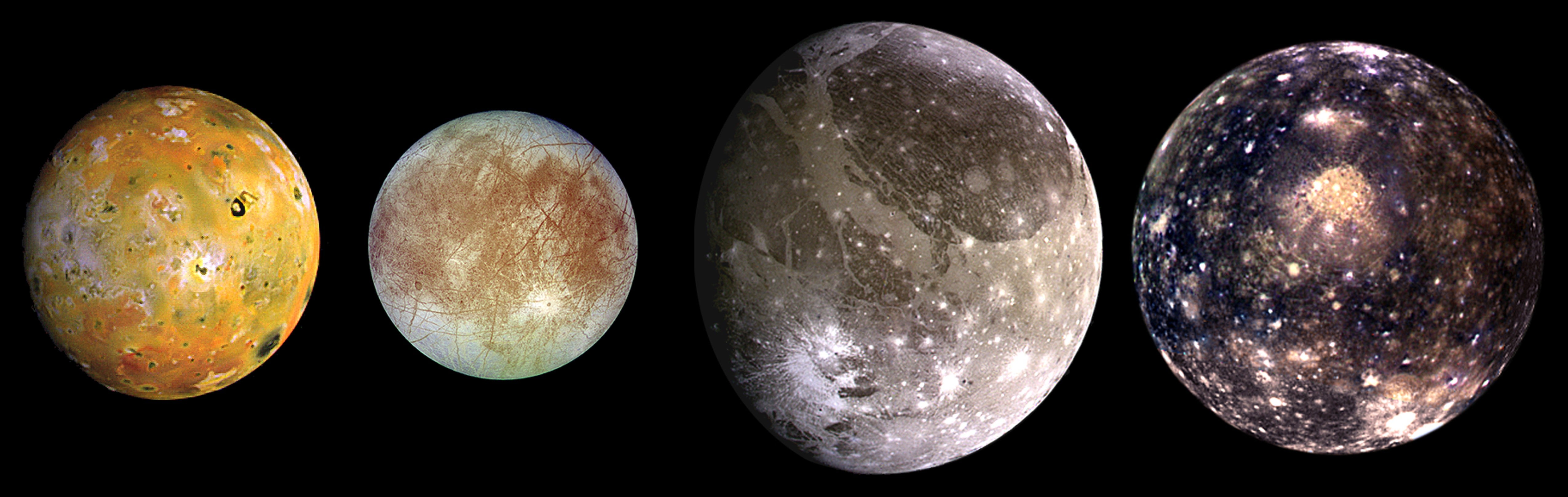
Freshly Baked Moons
Torn apart by Jupiter’s gravity, today’s Io is a hellscape of volcanic eruptions and the most active object in the solar system. But the team found that Jupiter’s youthful glow may have given Io an Earth-like temperature, and possibly an ocean, in the first place. I think there’s a good chance that there’s some water on the surface right after the blast,” Bierson says.
Things would have changed quickly, Biason said, because Io received about 30 times more energy from Jupiter than it receives from the Sun today. If Io had as much water as its brother Ganymede now contains, all that water would be quickly removed and the vestiges of the ocean would boil over in the first million years of the Moon’s existence. would have done
More distant than Io, Europa would have had slightly cooler surface conditions. Farther away, on Ganymede, Jupiter would have appeared barely brighter than the Sun does today. This is a level of solar radiation that does not significantly affect lunar ice. For the distant Callisto on the outskirts of the Jupiter system, Jupiter’s radiant youth would have had no effect. (This all assumes that the Moon was in its current position. However, it is possible that the Moon formed closer before it moved to its current location. That is, the results of this study means that it is likely only the lower bound of how much each moon is burned by Jupiter.)
“The nice thing about this hypothesis is that there are several tests that can be applied,” says Nimmo.
Proposals unique to JUICE
If Europa had lost most ice over its lifetime, instead of forming with less ice than its brothers, the hydrogen and oxygen left behind would have different isotopic fingerprints than the Ganymede and Callisto ices. will be Thus, isotopic comparisons between Europa and one or both of its outermost moons may finally reveal the truth about how these moons diverged from a common origin. “The more comparisons you can make, the more [among the chemistries of the moons]will give us a better understanding of how things evolved in this earliest era,” says Bierson.
Given the recent launch of the European Space Agency’s Jupiter Icy Moon Explorer (JUICE) mission, this is a rather attractive proposition. Between 2031 and her 2034, JUICE will make her 35 flybys of Europa, Callisto, and Ganymede before entering orbit around Ganymede. An extended tour could go a long way toward determining whether all Galilean satellites were born with the same amount of ice. Nimmo says it can make important measurements of hydrogen and water vapor that can be released into the atmosphere.
“The question is whether Ganymede is providing highly enough material for JUICE to sample,” says Nimmo. I’m sure he will.
Even if JUICE’s research doesn’t solve the case, JUICE isn’t the only spacecraft to probe the moons hanging around the Jupiter system. NASA’s Juno mission is already orbiting the gas giant, and the space agency’s Europa Clipper mission is set to launch next year for the mission’s eponymous voyage to the moon. The Clipper data provide strong comparisons with JUICE’s view of Europa’s ice, enough to extrapolate and distinguish what European spacecraft are seeing at Ganymede, and potentially at Callisto. must.
“Comparisons between satellites will be very important,” says Bearson. “It’s very exciting that both JUICE and Europa Clipper will be held at about the same time, with the potential for a bit of overlap.”
