











Scientists have scanned parts of the North Atlantic to reveal the remnants of a giant thermal rock pulsation that triggered a rapid climate warming event 56 million years ago.
A climatic event known as the Paleocene-Eocene Thermal Maximum (PETM) caused the then already hot climate to warm by about 5.6°C due to a sharp increase in atmospheric CO2.2Its greenhouse gas levels rose from about 1,120 ppm to about 2,020 ppm. This is much higher than today’s 417 ppm. Although it did not lead to a large-scale extinction, some deep-sea creatures and tropical plants became extinct. Scientists want to better understand PETM. Because this is an example of how the Earth reacted to her CO2 surge in the atmosphere.2 It’s a bit like what we’re experiencing now, even though it started with a hot, ice-free climate.
find the cause
The cause of PETM has been debated since its discovery in the 1990s, but evidence is accumulating that points to a large amount of CO.2 The main cause is methane released by volcanic activity in the North Atlantic. This activity created what is now known as the North Atlantic Igneous Region. This is the same kind of giant volcanic phenomenon associated with climatic disruptions and extinctions in other periods of Earth’s past, such as the end of the Triassic, the end of the Permian, and the early Jurassic. .
However, there is a problem with that explanation. The temperature rise at the beginning of PETM took him 3,000 to 10,000 years, but igneous activity lasted much longer, about 63 to 54 million years ago. If volcanic activity is the cause of PETM, then something extraordinary must have happened at the time of warming to distinguish it from the volcanic activity that preceded and followed it.The anomalous event was likely a geologically rapid magma surge that invaded oil-rich sediments and boiled CO.2 and methane. A paper published in 2019 showed how a giant pulse of hot mantle rock from a ‘mantle plume’ fed the magma that spreads beneath the crust.
In December, at the American Geophysical Union’s Fall Meeting in Chicago, the same team of scientists behind the 2019 paper proposed a giant slab of hot mantle rock, based on what was left in the North Atlantic. provided preliminary evidence that there was a significant pulsation.
Knight et al., AGU 2022 Poster V42F-0125.
“Early modeling shows that there is an expected crustal structure in the thickness of the oceanic crust that formed in response to very hot mantle temperatures,” said the candidate from the University of Birmingham, UK, “first We are very happy to know that the results of the study actually support our hypothesis.”
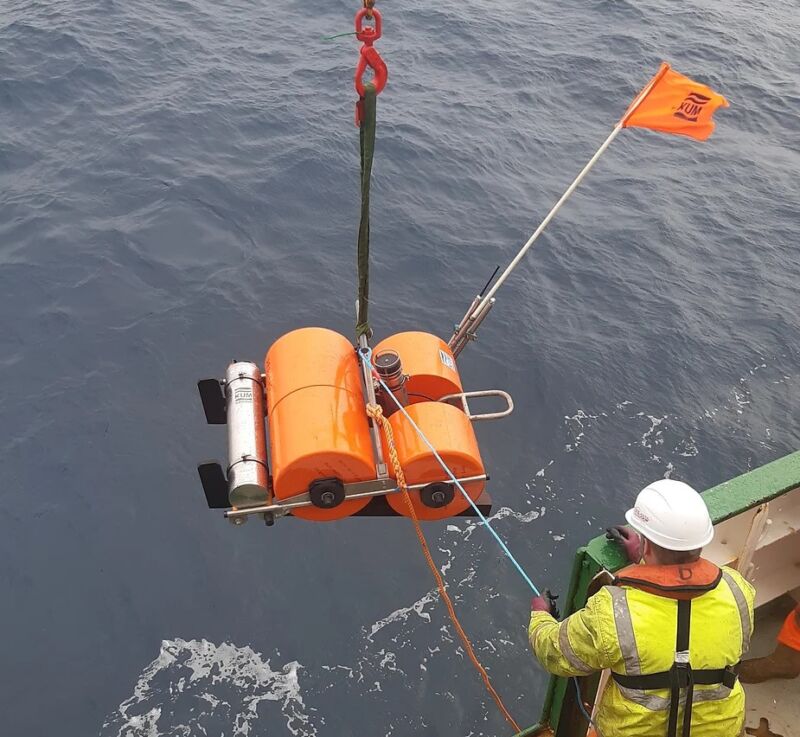
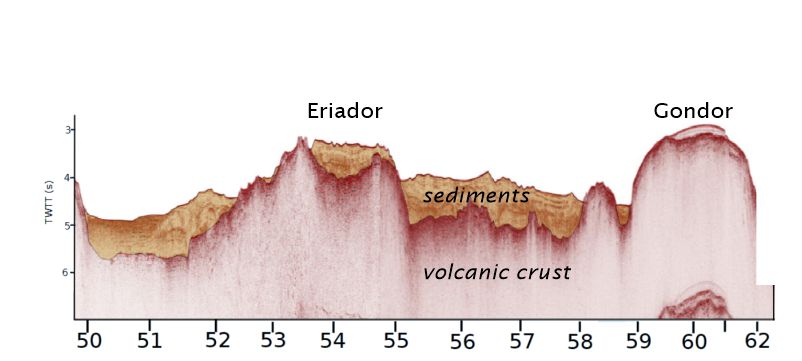
The evidence was collected in May 2021 from the seafloor beneath the stormy seas of the North Atlantic by scientists from the UK, Ireland and Denmark. They recorded a 400-kilometer-long cross-section through the Earth’s crust created using an ocean shock wave created by compressed air, recording echoes of the shock wave reflected from rock layers within the crust. I created an “earthquake profile”. Because this technology doesn’t penetrate deep enough to capture the entire crust, special microphones called “bottom seismometers” were placed on the ocean floor to record vibrations traveling down the crust. Combining the two types of seismic scans shows layers of marine sediment overlying volcanic rocks, indicating the thickness of the volcanic crust above the Earth’s mantle.
baked crust
A thicker crust indicates that the mantle was hotter when the crust was formed.
Also, the crust in the seismic section is younger in the west and older in the east, providing a record of the time leading up to PETM and subsequent mantle temperature changes. It shows a large uplift of thick crust, called the Eriador Ridge, which coincides with the timing of the PETM and supports the idea that a well-timed pulse of hot rock triggered a climate event.
But the true value of this work will become apparent when the magnetic data recorded by the 2021 expedition is used to accurately date along the lines of the seismic section. [seismic] profile,” said Knight.
These exact dates tell the team how fast the hot mantle pulse surged from where it first broke the crust (near today’s Iceland) to Eriador Ridge, 700 miles (1,000 km) away. will tell you. “It took a while for this pulse to spread, and its speed…is another very important factor in estimating the rate at which carbon was released,” Knight said. If it spreads very slowly, the same amount of carbon is released over a long period of time, and if it spreads very quickly, all that carbon is released very quickly.”
The significance of this is that, until now, the amount of carbon released to produce PETMs was calculated from the aftereffects of emissions, such as changes in ocean chemistry recorded in plankton fossils that were alive at the time. . However, Knight’s colleagues at the University of Birmingham can get closer to calculating the emissions from the other end, allowing them to calculate the amount of CO.2 It was actually ejected by lava and magma-fired sediments.
“We’re estimating carbon emissions directly from the source, rather than estimating the carbon released from the impact on what’s changed,” Knight explained.
