











Bite (noun): more meaty news to sink your teeth into.
Bark (noun): peripheral noise worth your attention.
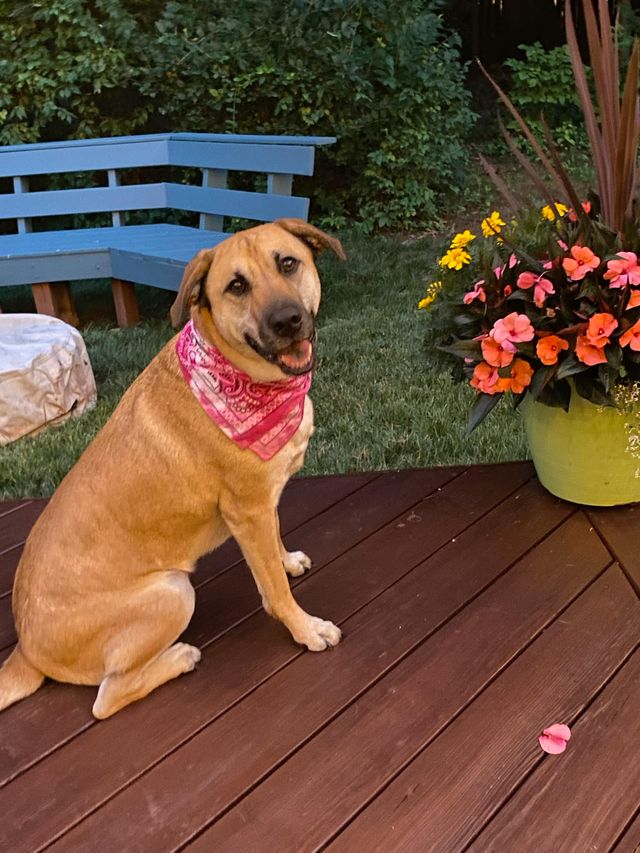
Gary Lobel‘s Dog, Eevee.
This week in Other Barks & Bites: the U.S. Copyright Office issues a report on digital replicas recommending a federal right that could be enacted in the U.S. Senate’s NO FAKES Act; the RESTORE Patent Rights Act is introduced into both houses of Congress to restore injunctive relief following a final judgment of patent infringement; the Eleventh Circuit ruled that a district court erred in failing to consider the copyrightability of the arrangement of software used to generate insurance quotes; China announces massive growth in the number of domestic patents protecting generative artificial intelligence inventions; the U.S. Chamber of Commerce warns about march-in rights threatening partnerships with private research companies seeking funding under the CHIPS and Science Act; the International Olympic Committee announces a robust anti-counterfeiting program for official Paris 2024 apparel and merchandise; and a miss on revenue growth expectations for cloud services leads to a significant drop in Microsoft stock value.
Bites
CAFC Says Appellate Arguments Not Forfeited if Not Included in PTAB Rehearing Request – On Thursday, August 1, the U.S. Court of Appeals for the Federal Circuit issued a precedential decision in Voice Tech Corp v. Unified Patents, LLC affirming the Patent Trial and Appeal Board’s (PTAB) invalidation of patent claims covering voice command control of mobile devices owned by Voice Tech. Despite affirming the invalidation ruling, the Federal Circuit held that Voice Tech was not prohibited from raising claim construction arguments that the patent owner did not include in its request for rehearing, noting that such requests are voluntary and thus not required to preserve appellate arguments.
Eleventh Circuit Remands to Assess Copyrightability of Software Code Arrangement – On Thursday, August 1, the U.S. Court of Appeals for the Eleventh Circuit issued a ruling in Compulife Software, Inc. v. Newman reversing the Southern District of Florida’s ruling that Compulife’s software code for generating life insurance quotes is unprotectable. The Eleventh Circuit found that the district court erred by not considering the copyrightability of the entire arrangement of Compulife’s software code, including the arrangement of code components used to collect health and insurance information for generating insurance quotes.
Copyright Office, Senate Bill Seek Enactment of Federal Right to Digital Replicas – On Wednesday, July 31, the U.S. Copyright Office issued the first part of the agency’s report on legal issues impacted by generative artificial intelligence (AI) systems, recommending the creation of a federal right to digital replicas that covers all individuals and is licensable as a property right. On the same day, a bipartisan coalition of U.S. Senators including Chris Coons (D-DE), Amy Klobuchar (D-MN), Thom Tillis (R-NC) and Marsha Blackburn (R-TN) introduced the Nurture Originals, Foster Art, and Keep Entertainment Safe (NO FAKES) Act, which would establish a federal right to an individual’s voice and likeness following many of the same contours recommended in the Copyright Office’s report.
Bipartisan, Bicameral RESTORE Patents Rights Act Would Restore Injunctive Relief – On Tuesday, July 30, Senators Chris Coons (D-DE) and Tom Cotton (R-AK), along with Representatives Nathaniel Moran (R-TX) and Madeleine Dean (D-PA), introduced the Realizing Engineering, Science, and Technology Opportunities by Restoring Exclusive (RESTORE) Patent Rights Act into their respective houses of Congress. If enacted, the bill would amend 35 U.S.C. § 283 to create a rebuttable presumption that a patent owner is entitled to injunctive relief if they obtain a final judgment of patent infringement from a U.S. court.
U.S. Chamber Says March-In Rights Framework Threatens CHIPS and Science Act Investments – On Monday, July 29, the U.S. Chamber of Commerce published a policy article decrying the Biden Administration’s proposals on exercising march-in rights under the Bayh-Dole Act to control consumer pricing on inventions developed with federal funding, noting that such compulsory licensing activities pose a major threat to the development of semiconductor manufacturing and other critical technologies that are targeted by the $53 billion in federal funds earmarked by the CHIPS and Science Act by discouraging private businesses from entering partnerships with federal agencies necessary to develop such innovations.
CNIPA Announces Major Growth in Chinese Generative AI Patents and IP Exports – On Monday, July 29, China’s National Intellectual Property Administration (CNIPA) announced that there were 378,000 valid Chinese patents covering generative artificial intelligence (AI) inventions as of the end of 2023, representing a year-over-year growth of 40% at a growth rate 1.4 times higher than the global average, according to Chinese state-owned media. The following day, on July 20, Chinese state-owned media also reported that CNIPA data showed that exports covered by domestic intellectual property rights reached 180 billion yuan ($24.8 billion USD) during the first five months of 2024, a 17.7% increase when compared to the first five months of 2023.
Barks
Third Circuit Affirms Denial of Default Judgment for Failure to Allege Consumer Confusion – On Wednesday, July 31, the U.S. Court of Appeals for the Third Circuit issued a decision in Meenaxi Enterprise, Inc. v. Singh Trading Co., Inc. in which the appellate court affirmed the District of New Jersey’s denial of default judgment to Meenaxi after finding that the “BOURNVITA” chocolate milk powder allegedly infringing on Meenaxi’s trademark was a genuine article and that Meenaxi did not properly allege that Singh Trading’s product created a likelihood of consumer confusion.
EPO Moving to Electronic-Only Patent Citations in October – On Wednesday, July 31, the European Patent Office (EPO) announced that the agency will discontinue the practice of providing paper versions of patent documents that are cited during search and examination procedures and will send such documentations in an electronic-only format starting October 1 of this year.
International Olympic Committee Announces Anti-Counterfeiting Program for Paris 2024 – On Monday, July 29, the International Olympic Committee (IOC) issued a press release announcing that it has been working with the organizers of the Paris 2024 Olympic Games to establish a comprehensive anti-counterfeiting program for athletic apparel and other merchandise, including advanced technological measures for authentication and traceability on official products as well as counterfeit detection training for more than 20,000 law enforcement officers.
Judge Wolson Enters SJ for Intel in Patent Case Over Prosecution Disclaimer – On Friday, July 26, U.S. District Judge Joshua D. Wolson entered a ruling on summary judgment in favor of defendant Intel in an infringement lawsuit over efficient data processing architecture patent claims owned by PACT XPP Schweiz after finding that PACT had made contradictory statements regarding claim construction to the U.S. Patent and Trademark Office during ex parte reexamination proceedings petitioned by Intel in order to distinguish its claims from the prior art.
Gloria Gaynor Files Copyright Infringement, Breach of Contract Claims Against Former Producer – On Friday, July 26, renowned disco singer Gloria Gaynor and songwriter Robin Randall filed a lawsuit in the Southern District of New York asserting copyright infringement, breach of contract and other claims against American record producer Joel Diamond. The pair allege that Diamond has wrongfully maintained that several Gaynor tracks were recorded as works for hire and that Diamond fraudulently induced Randall’s mother Judithe Randall to assign ownership rights to songs co-written by the Randalls while Judithe was significantly ill and incapacitated.
This Week on Wall Street
Cloud Revenue Miss Drops Microsoft Share Value Despite Earnings, Revenue Beats – On Tuesday, July 30, shares of Microsoft stock dropped by 7% during extended trading due in large part to missing revenue growth expectations for Azure and other cloud services offered by the software giant, despite beating analyst expectations on both earnings by $0.02 per share and quarterly revenues by about $340 million.
Quarterly Earnings – The following firms identified among the IPO’s Top 300 Patent Recipients for 2023 are announcing quarterly earnings next week (2023 rank in parentheses):
- Monday: Berkshire Hathaway Inc. (199th); Infineon Technologies AG (53rd)
- Tuesday: Bayer AG (132nd); Cirrus Logic, Inc. (251st); Daikin Industries, Ltd. (t-179th); GoPro, Inc. (t-232nd); Mazda Motor Corp. (240th); Mitsubishi Heavy Industries Ltd. (133rd); Schaeffler AG (t-252nd); Softbank Group Corp. (t-169th)
- Wednesday: Continental AG (195th); Emerson Electric Co. (t-158th); Fujifilm Holdings Corp. (29th); Honda Motor Corp., Ltd. (28th); Kubota Corp. (t-288th); Sonos, Inc. (t-211th); Sony Group Corp. (14th); Sumitomo Rubber Industries, Ltd. (t-244th); Walt Disney Co. (t-272nd)
- Thursday:com, Inc. (t-258th); LG Corp. (2nd); Nikon Corp. (280th); Terumo Corp. (243rd); Tokyo Electron Ltd. (71st)
- Friday: Kubota Corp. (t-288th); Magna International Inc. (129th); Sharp Corp. (93rd)