











Arizona law firm, Lerner & Rowe PC (L&R) is a widely recognized personal injury law firm in Arizona, with over 100,000 clients since 2005. That recognition as a brand comes at least in part by spending over $100 million promoting and advertising its trademarks through radio, television, print publications, billboards, and other marketing materials. A competing law firm, Brown Engstrand & Shelly LLC, using the brand name Accident Law Group (ALG), was founded in 2015. ALG purchased keyword ads via Google AdWords that were shown when people searched for “Lerner & Rowe”, the federally registered trademark of their largest competitor. When potential clients searched for Lerner & Rowe by name, Accident Law Group’s ads would prominently appear.
Here is a reproduction of one of the ads:
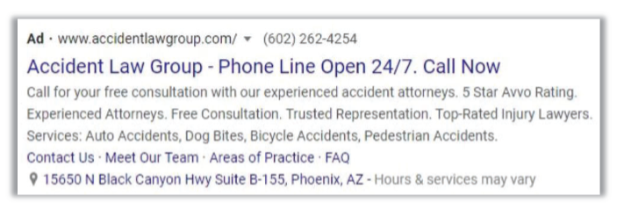
Lerner & Rowe filed a lawsuit in 2021 claiming ALG’s practice was trademark infringement.
Lerner & Rowe PCv. Brown Engstrand & Shelly LLC (a.k.a. Accident Law Group)
Through discovery, L&R found that ALG had data from their call center logs, which tracked the volume and source of calls received over several months. Their data showed that the call center handled around 10,000 calls from potential clients while running the Google Ads in question.
Out of these calls, Lerner & Rowe identified a small subset—approximately 2%—where the callers to ALG may have been confused about the firm they were contacting. These callers may have initially intended to reach Lerner & Rowe but had clicked on ALG’s ad instead, mistakenly believing that ALG was affiliated with or a part of Lerner & Rowe. This amounted to 236 potentially confused consumers. In this group, L&R identified 98 log entries where the potential client said they were “looking for” Lerner & Rowe, “calling for” Lerner & Rowe, that they “wanted” Lerner & Rowe, or they stated explicitly that they thought Accident Law Group was Lerner & Rowe. While the percentage of total call volume (2%) might seem small, Lerner & Rowe argued that each lost client represented significant potential revenue and that ALG’s actions were eroding their brand equity.
On the other side, ALG contended that their advertising practices were completely lawful and that they were merely competing in a crowded market. They argued that the confusion was minimal and that the ads were clearly labeled, ensuring that any consumer who clicked through to their site would quickly realize they were dealing with a different firm.
The court faced the challenging task of evaluating the likelihood of confusion in this digital context. While the 2% confusion rate was not negligible, the court ultimately concluded that Lerner & Rowe had not provided sufficient evidence to prove that ALG’s actions were causing significant consumer confusion on a broader scale. The court noted that the mere use of a competitor’s trademark as a keyword did not inherently constitute trademark infringement, especially when the ads were not misleading.
First Summary Judgment Ruling
In its initial ruling, the district court denied L&R’s motion for summary judgment, and granted, in part, ALG’s motion for summary judgment, finding that the confusion was minimal and not enough to constitute trademark infringement. The founder of ALG, Joseph Brown, was also named as a defendant. The district court granted ALG’s motion for summary judgment, but not as to Joseph Brown, leaving Brown as a defendant. ALG filed a motion for reconsideration, arguing that without likelihood of confusion, all claims against Joseph Brown also failed.
Second Summary Judgment Ruling
In a surprising turn, the court agreed to reconsider its ruling. This time, the court took a closer look at whether all of Lerner & Rowe’s claims—under both the Lanham Act and Arizona common law—required proof of consumer confusion. After a thorough review, the court once again sided with ALG, and this time also granted summary judgment for the claims against Joseph Brown. The district court said:
“all of Plaintiff’s claims require a likelihood of confusion. Plaintiff has identified no source of confusion in this case other than Defendants’ purchase of Plaintiff’s trademark as Google keywords.”
It added:
“it makes no sense to suggest that the tort of unfair competition can be established simply by proving the parties compete.”
Purchasing Keywords as Trademark “Use In Commerce”
One of the issues in trademark law that past courts have addressed is whether it is considered trademark use to purchase AdWords to trigger an ad that does not use the trademark in any way. In 2011, the Ninth Circuit ruled in Network Automation, Inc. v. Advanced Systems Concepts that purchasing keywords containing a trademark without displaying the trademark satisfies the “use in commerce” element required for trademark infringement. A plaintiff would still need to prove that confusion was likely based on trademark factors to show infringement.
Appeal to the Ninth Circuit
Lerner & Rowe filed an appeal with the U.S. Court of Appeals for the Ninth Circuit. At the time of writing this article, oral arguments are completed, and the parties are waiting for a decision from the court. One major part of trademark law that many attorneys do not understand is that trademark cases are highly fact specific. This makes it difficult at times to rely on precedent. The Lerner & Rowe case is no different.
One of the foundational cases on purchasing trademarked AdWords is Network Automations. The opening line of the opinion quotes another case:
“We must be acutely aware of excessive rigidity when applying the law in the Internet context; emerging technologies require a flexible approach.” Brookfield Commc’ns, Inc. v. West Coast Entm’t Corp., 174 F.3d 1036, 1054 (9th Cir.1999).
It is difficult to determine how to follow precedent when using a “flexible approach”. This may be interpreted as a signal to allow courts to distinguish the fact pattern of the present case from the precedent cases.
Oral arguments for the appeal were before Justice Roopali Desai, Justice Ana de Alba, and Justice Edward M. Chen, with Attorney Andrew Gaggin arguing for L&R, and Attorney Maria Crimi Speth arguing for ALG.
The first two factors, strength of the mark, and proximity or relatedness of the goods or services likely will remain the same for the analysis and were not addressed during oral arguments.
Similarity of the Marks
The third factor of similarity of the marks, however, cannot be analyzed in the same way as other cases. When someone purchases AdWords services for a trademarked term, the customer is not shown a similar trademark of another company that may cause confusion. There is no comparison of two different trademarks, because the question is not whether the trademarks are similar, but whether the behind-the-scenes use of the trademark is likely to cause confusion. The trademark owner is likely to purchase AdWords for their own trademark as well, which can result in a link to the services of the trademark owner being displayed next to the services of the competitor, which was the case with ALG’s ads.
Evidence of Actual Confusion
A majority of the time in oral arguments before the Ninth Circuit was spent on the factor of actual confusion. In trademark law it is difficult, if not impossible, to recreate the actual experience that all consumers have when interacting with a competitor’s brand that is alleged to be infringing, including their state of mind and whether they are confused. With AdWords we can get a little closer than in other cases because we can determine more of what was on the screen when the ad was presented, and how many times it was presented. Because it is difficult to recreate the experiences of all the consumers, when an actual case of confusion is found, the courts usually take that as a strong indication that there are many more consumers that have been confused that they were not able to capture.
The challenge for the district court and now the Ninth Circuit is to determine how the extra information about how many people were shown the ad, how many clicked on the Ad, and call center records that indicate how many people mentioned L&R, the owner of the trademark when calling ALG. One question explored by the Ninth Circuit at oral arguments was: Does the data show the whole universe of potentially confused people, and does the data properly capture how many of those people showed some trademark confusion? If the answer is yes, then the Ninth Circuit indicated that we can treat the results of the data as we do a survey. If the results of a survey show that only 2% of people are confused, then usually the court will say that is an indicator that consumers are not “likely” to be confused, even though a small percentage showed confusion.
The Attorney for Lerner & Rowe asked the court to consider that just one case of actual confusion is strong evidence that the defendant’s use of their trademark is likely to cause confusion. In oral arguments, however, one of the judges on the three-judge panel distinguished from the precedent cases where just one case of actual confusion would be enough. The judges said that in most cases you know the numerator, or how many instances of actual confusion are found, but you don’t know the denominator, which is the number of people who were presented with the ad that is at issue. Here, the judges said that we do know the denominator, because undisputed evidence was presented of how many times the google ad was shown, and how many times people clicked on the ad. The highest number for the numerator in this case comes from the call logs of the call center, where Lerner & Rowe was mentioned around 236 times by callers. There is dispute as to what the exact number is for the denominator, whether it is the 109,000 impressions that the ad received, or the 7,400 clicks on the ad, or the 10,000 consumers that called the call center. In the best case, with the largest numerator and smallest denominator, the percentage would be around three percent. Usually, the 10,000 is used for the denominator, which leads to the 2% figure. The attorney for Accident Law Group also argued that if you used the 109,000 impressions as the denominator, the percentage is around 0.2 percent.
The idea that you can capture the entire universe of the alleged trademark infringement is one reason that Justice Edward M. Chen, of the Ninth Circuit appears to favor applying the Sleekcraft factors differently in AdWord cases.
Oral arguments did not address the Sleekcraft factors of marketing channels, the defendant’s intent, or the likelihood of expansion, although the written opinion of the court may address these factors.
Degree of Consumer Care
The final Sleekcraft factor that was addressed in oral argument was the degree of consumer care. The court appears to distinguish the present case of L&R v ALG, where the consumer is someone that has been injured with pressing needs, from the consumer in the Network Automation case where the consumer was purchasing business software.
It can be difficult to rely on precedent because of the rapidly changing consumer experience when using the internet, which is discussed in the following exchange in oral Arguments:
Andrew Gaggin Attorney for L&R: Google has taken steps over the past decade to make their ads look more uniform with the organic results, specifically to get people to click on the ads more often instead of clicking on the organic results, because they make money off of clicks.
Justice Chen: And I think all of us have noticed that over the years. It used to be on the side banner and stuff and we could ignore it. Now it’s, you’ve got to scroll down like five rolls of the scroll to get to what you want. But it seems like most people know that now. And, and that’s just part of the sophistication of the internet user. You know whether you’re on Google or looking for a restaurant on Yelp or whatever. You’ve got to get through the sponsored ads, the ad ads, and all sorts of stuff before you get to the Organic ads. I think that’s a, isn’t that a fact of life? That people using the internet, especially if you’re looking for a specific law firm for personal injury, the reasonable user would know that. The first thing that pops up is not necessarily it.
On the one hand, consumers looking for relief from the challenging situation after being in an accident may be rushing to find someone that can help them, and their decision making may not be sophisticated at that point like when purchasing a luxury vehicle. On the other hand, internet users have become highly experienced when interacting with search results, including the ads shown with search results.
Oral arguments took place on May 14, 2024, three months before this article was written. We are waiting for a ruling from the Ninth Circuit on this case.
A Thin Line
The use of competitors’ trademarks in keyword advertising is a still a risky strategy. The line between competitive marketing and trademark infringement is thin and will likely turn on the specific facts of the case. Businesses must carefully consider the legal risks associated with this practice, as courts have shown a strong willingness to protect consumers from confusion and uphold the integrity of trademarks. The 9th Circuit Court of Appeals may decide that the internet consumer in 2024 is sufficiently experienced with ads to expect a search engine to display ads, and know that the ad may be a different brand than the one they were searching for.
For more information about using trademarks for keywords, see the latest episode of Leveraging Inspiration. And here are links to additional episodes that specifically discuss using trademarked keywords:
Can I Use My Competitor’s Trademark in Keyword Ads – Understanding Trademark Use in Advertising
More podcast episodes regarding using trademarked keywords.
