











“Judge Braden implored attendees to push the issue of protecting IP rights more forcefully, emphasizing how crucial they are to the U.S. economy and the foundation of democracy, despite being largely overlooked by mainstream media.”
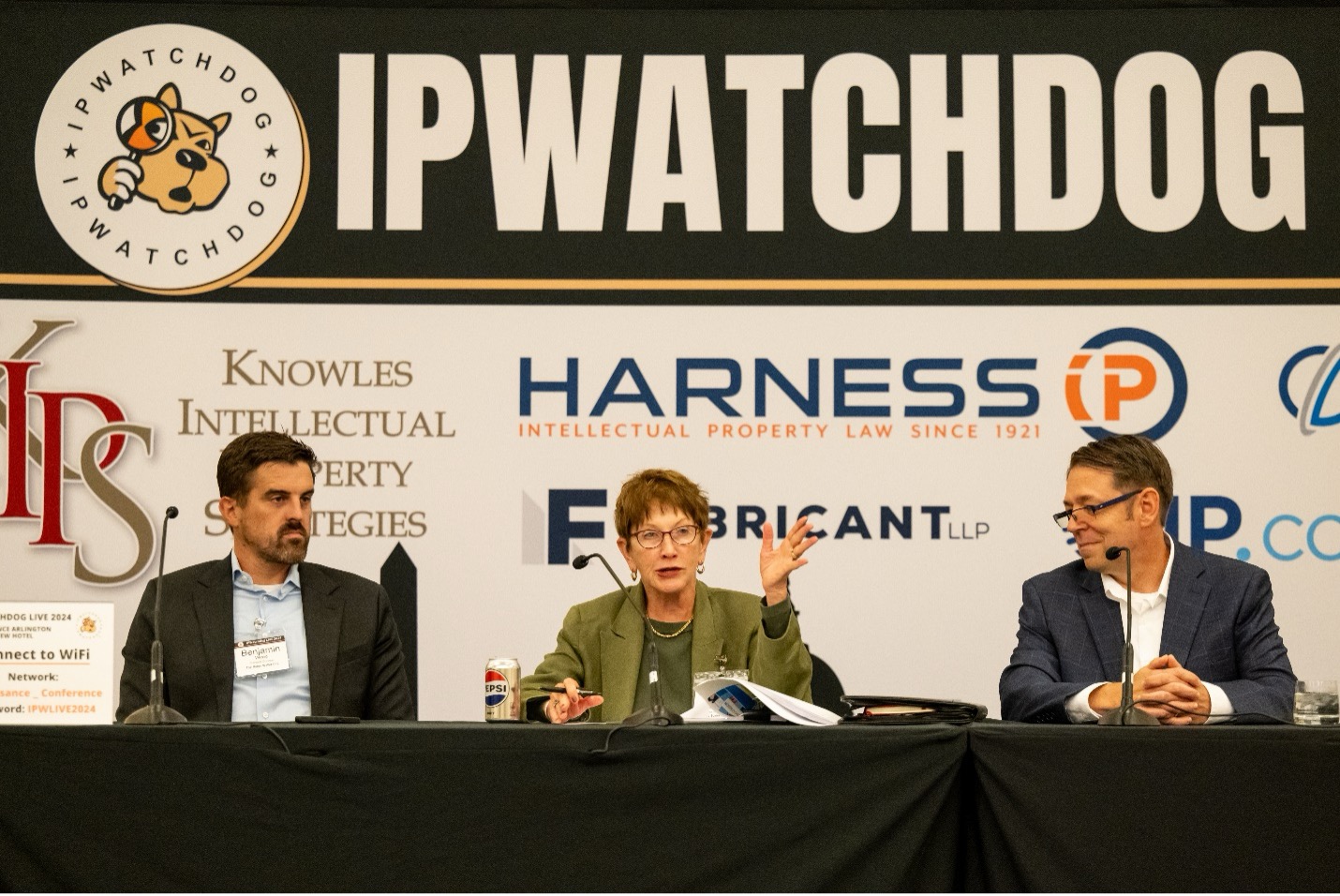
Left to right: Benjamin Weed, Judge Susan Braden, Dean Geibel.
IPWatchdog LIVE 2024 kicked off on Sunday, September 29, with a panel that delivered clear insights on the current state of U.S. intellectual property, offering key takeaways for policymakers, staffers, in-house counsel, attorneys, and patent practitioners alike. Moderated by Judge Susan Braden, panelists included Dean Geibel, Chief Patent Counsel & Associate General Counsel at Samtec, Inc., and Benjamin Weed, General Counsel at Ridge Wallet.
Setting the Stage
Judge Braden began by expressing gratitude to IPWatchdog, commending their consistent efforts in “looking for ways to fix the system and bringing people together.” She also praised IPWatchdog’s willingness to speak out in support of Judge Pauline Newman when other organizations “didn’t make a peep.”
Braden then underscored the high stakes of the upcoming election for intellectual property rights and innovation, asserting, “We are doing such a good job destroying our own economy we don’t need to worry about the Chinese; we’re going to do it all on our own.” Braden implored attendees to push the issue of protecting IP rights more forcefully, emphasizing how crucial they are to the U.S. economy and the foundation of democracy, despite being largely overlooked by mainstream media.
Turning to the U.S. Chamber of Commerce’s International IP Index, Judge Braden compared the United States’ performance to other nations. While the U.S. scored highly in “Enforcement” (96%), surpassing China’s 37%, she noted that progress in the United States and EU has been stagnant while Saudi Arabia, Brazil, and Nigeria are improving. “We don’t know how to use our laws right,” she quipped.
The U.S. lagged behind other leading nations Switzerland, South Korea, Japan, and leader Singapore (97.2%) in “Patents, Related Rights, and Limitations,” with China (80.8%) showing improvement. “They are on the rise… and we have remained stagnant,” Braden said. In “Commercialization of IP Assets,” the United States ranked third (91%), behind Israel and Australia (both at 95.8%), while China scored 38.83%.
What Can the U.S. Do to Improve the System for Innovators and Creators?
A key frustration voiced by panelists was the weakness of the U.S. system regarding injunctive relief. Benjamin Weed of Ridge Wallet shared the experience of their young founder being advised against filing patents early on, only to face widespread copying of their innovation a few years later. Dean Geibel of Samtec pointed out that U.S. patent law offers limited practical help when products are manufactured and consumed primarily in China.
Weed suggested pursuing improvements throughout the patent process, from procurement to judgment, to enhance efficiency. First emphasizing the difficulty of obtaining injunctive relief, he then proposed mandatory mediation and arbitration after claim filing to mitigate the high costs of litigation. Judge Braden agreed, highlighting the exorbitant expense of discovery and suggesting procedural changes, potentially at the Patent Trial and Appeal Board (PTAB) level, to mandate mediation. She also raised concerns about confidentiality orders and associated data privacy and trade secret concerns arising from overly litigious patent proceedings. “It’s not just cost of litigation, it’s the cost of discovery itself. The cost…is that these people know an awful lot about your business, and you don’t know who is on the other side sometimes— who’s funding the litigation and why it’s being brought.”
Weed further noted the public nature of many proceedings and briefs, which are followed closely by efficient infringers overseas, a significant challenge for companies like Ridge. While the United States may be isolated geographically, the internet, and the prevalence of English, often makes monitoring of proceedings equally easy from overseas.
Geibel observed a decline in U.S. innovation post-Cold War, with decreased R&D spending and increased reliance on foreign manufacturing. He expressed concern about the long-term implications of this trend, arguing that technological innovation remains America’s key competitive advantage.
Navigating Policy and International Challenges
Judge Braden also discussed the Bayh-Dole Act and the success of university tech transfer offices. She expressed alarm about recent NIST guidelines impacting federally funded research, characterizing them as a potential “tax on American manufacturing.” She criticized the short comment period and the prevalence of allegedly robo-generated comments supporting the guidelines.
Geibel cited a February IPWatchdog article detailing the Chinese government’s targeting of foreign patents in China, including those related to standard essential technologies. He contrasted this with proposals to crack down on continuation practice and again noted the difficulty of obtaining injunctions in the United States, arguing that, while China strengthens its IP protections, the United States appears to be weakening its own.

