Support IPWatchdog with an individual sponsorship: Click here
In this episode of IPWatchdog Unleashed, we discuss patent prosecution with the director of intellectual property at one of the top five filing companies in the world. My friend, Sivon Kalminov, is the Director the Intellectual Property Division at Canon USA, where he is responsible for managing the Division’s day-to-day patent prosecution work, which includes overseeing both the patent prosecution and administration departments. He also provides support on patent litigation matters, contract matters, and general U.S. patent law-related advice to various domestic and international Canon companies and subsidiaries. He is a current member of the California State Bar Intellectual Property Section, and a past Chair of the Section.
Our wide-ranging conversation took place in person on October 1, at IPWatchdog LIVE, shortly after Sivon spoke on a panel about strategies for getting to yes when working with patent examiners.
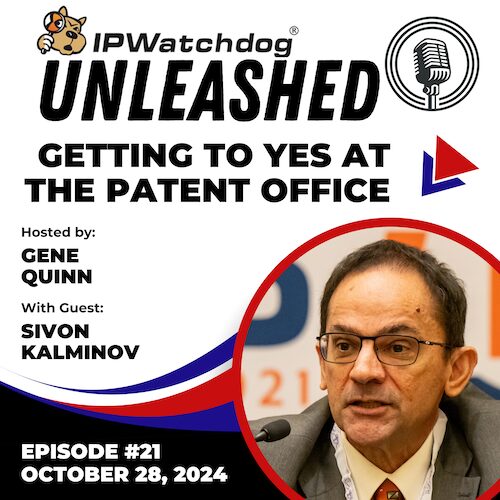 During our conversation, we discuss the unique set-up of the Canon intellectual property department, which sees Sivon and his team representing Canon USA, but also representing various Canon entities from around the world as they enter the United States to obtain patents on previously filed applications. We also discuss the U.S. Patent and Trademark Office (USPTO) switching from EFS-Web to Patent Center, the unceremonious death of the After Final Consideration 2.0 program, examiners raising Section 112 and Section 101 issues for the first time in a Notice of Allowance, strategies for working with examiners, the importance of interviews to get on the same page with examiners, when and whether it is appropriate to appeal examiner rejections to the Board, and much more.
“The main Canon IP department is located in Canon, Inc. in Japan,” Kalminov explains. “They control all global IP for Canon, just because it is a global company. So, they are the central hub. But the way they have it set up—they have regions. So, they have Canon USA and Canon Europe, for example. And so, our responsibility is to handle Canon IP for the US. They use outside law firms, but over the years, we’ve kind of started moving a lot of stuff in-house.”
Setting up the legal department in this way was a conscious choice, according to Kalminov, and was based on cost savings, but also comes with other benefits.
“It’s also a lot more efficient because we have direct access to the inventors in Canon Americas,” Kalminov explained. “We also have basically direct access to the inventors in Canon Inc. So, if we have an office action for a Canon, Inc. case that we need help with, we don’t have to go through an intermediary. We can go directly to Canon, Inc. and have a conversation if needed with the inventor there. So, that kind of makes things a little more efficient because we’re part of the family, so to speak.”
One of the more interesting points to come out of our conversation related to the frustration of going through an entire case, finally reaching the Notice of Allowance (NOA) stage, and the examiner raising a Section 112 issue, for example, with the examiner for the first time mentioning that the claims will be considered to have invoked 112(f) and treated as means-plus-function claims.
“One of the things that does tend to sometimes be frustrating is I won’t see a 112 until the NOA,” Kalminov explained as he discussed how frustrating it is to receive two office actions with neither raising 112 as an issue, “but then all of a sudden in the Notice of Allowance it pops up… I have to go back to the [Canon entity] and say, oh, by the way, I got this 112 interpretation. What do you want to do? Do you want to just leave it and let the ‘unit’ be interpreted as it’s described in the spec? Do you want to try to update the claim? What do you want? And that kind of slows down the issuance process. So yeah, that’s a little puzzling as to why all of a sudden am I seeing this in an NOA.”
The day before our conversation, the USPTO announced that they would sunset the After Final 2.0 program, saying it is too expensive.
“It was an effective tool that we took advantage of,” Kalminov explained. “I’m a little sad that it’s being phased out, but it is what it is, and we’ll just have to adjust what we’re doing to figure out what’s the next most efficient thing for us moving forward.”
For the full conversation, you can listen wherever you get your podcasts (links here) or visit IPWatchdog Unleashed on Buzzsprout.