











In 2017, Christie’s auctioned the most expensive painting in history. It was Leonardo da Vinci’s “Salvatore Mundi” and sold for $450 million. The term “attribution” is key here. Controversy over the work’s authorship has continued since the work was identified ten years before her auction. There is also a documentary about its history. In fact, scandals over the attribution of counterfeit and inaccurate works of art are commonplace in the art world. but, Artificial intelligence It may be easier for the responsible professional to put a stamp of authenticity.
The new tool, developed by Case Western Reserve University in the United States, has surprised the researchers themselves with its accuracy. The test compared the work of four artists, Identified the author with 95% accuracyThe creators of this artificial intelligence technology point out that the system can identify a kind of “fingerprint” of an artist that is imperceptible to the human eye. Another analogy is a person’s own handwriting transferred to a paintbrush stroke. But how does it work?
3D Topography: A New Way to Interpret Art
One of the keys is the fact that neural networks are not limited to analyzing handwriting shape. The study, published in Heritage Science, explains that the starting point is a 3D scan of a painting. The device used to accomplish this is known as a chromatic confocal profilometer. This machine uses light and color to detect the most subtle textures.
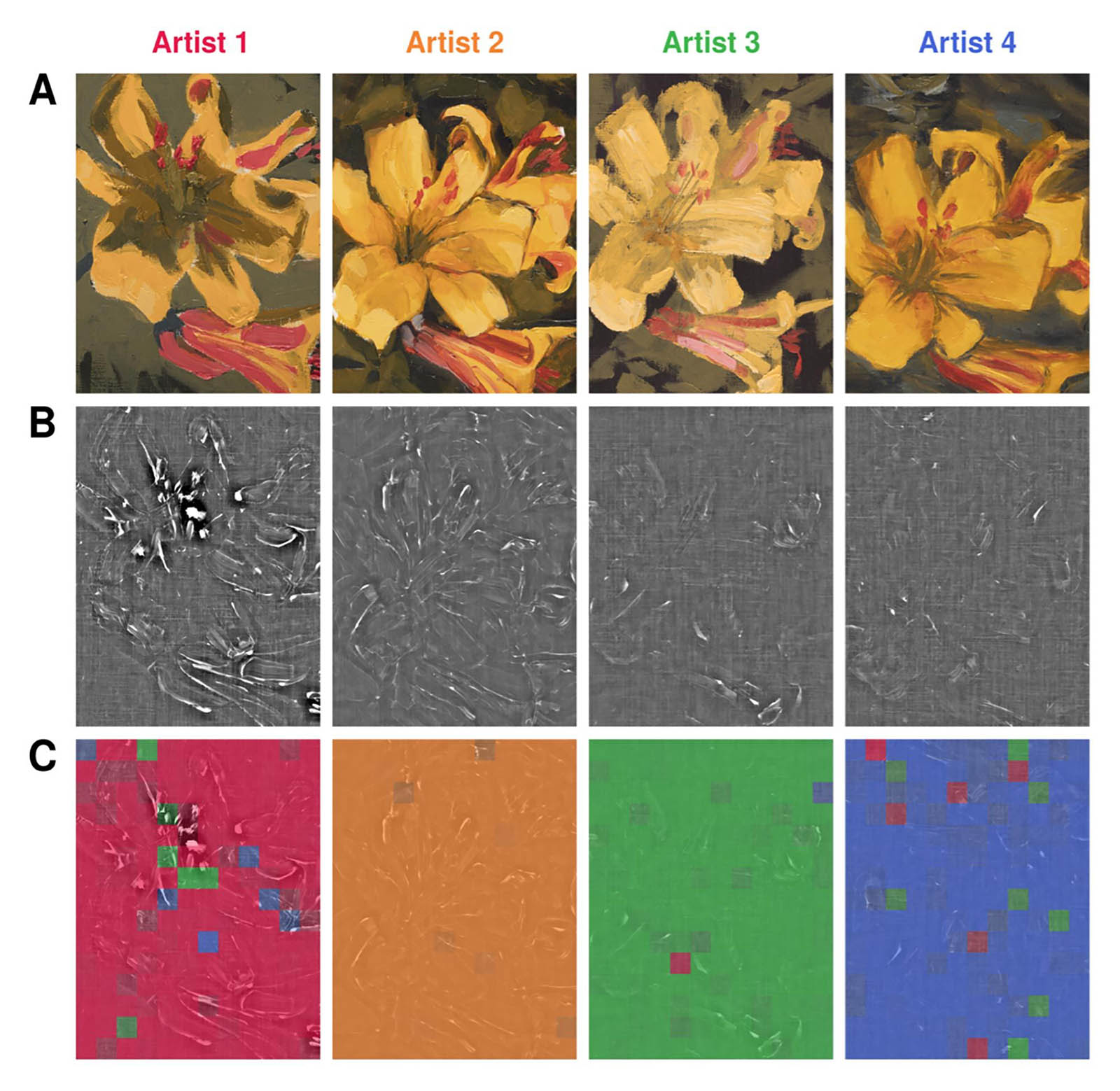
Therefore, when this 3D map is acquired, the artificial intelligence system can Compare different reliefs of each work, including the dips and bumps of the oil used. Additionally, this test looks for nearly fine patterns, roughly the diameter of the bristles of a paintbrush.
Researchers note that unlike previous AI systems, neither the entire work nor the subject matter is recognized. Small areas ranging from millimeters to centimeters are being studied. Once the software is trained, a small area of the painting is sufficient to identify the author.
In addition to Helps recognize counterfeits and establish authorshipwith this revolutionary technology, Parts of the same work correspond to authorsThis is a problem that arises mainly in classical works, such as those of Velázquez and other painters who relied on the help of collaborators to complete the most tedious parts of their paintings. Sometimes this practice obscures the authorship of the work.
Thus, some paintings attributed to the artist later came to be considered the work of his school or his assistants. Recently, a painting attributed to Van Dyck’s school turned out to be the work of a famous Dutch painter. In fact, Salvatore Mundi itself unfolds part of the debate around the possibility that most of the painting could be the work of da Vinci’s assistant, Bernardo Luini.
Artificial Intelligence: From Identification to Artistic Creation
Artificial intelligence in the art world is beginning to demonstrate certain skills not only in the analysis of paintings, but also in the creative field. In 2018, Christie’s auctioned the first painting created by artificial intelligence. “Portrait of Edmond Bellamy” sold for over $400,000 of her, but that sum went not to her AI, but to her Obvious, a French art collective.
One artist exploring the possibilities of AI applied to art is Refik Anadol.In his case, instead of creating simple paintings, the artist chose grand art installations. big data A machine learning algorithm for creating animations that visualize complex databases. Thus, each point displayed and moved corresponds to a data entry. Anadolu tries to answer the question: can data be pigment?
In recent years, so-called “generative art” has begun to increase rapidly in line with these creations. In the heat of NFT and blockchain technology, many artists are using algorithms to create a series of digital works. who is the author? AI programmer? What artists create the settings? Even Isaac Asimov, who created the famous laws of robotics, could not have predicted that one day technology would also question the notions of the artistic author.
sauce: TechExplore
