











Despite numerous scientific and technological breakthroughs, storing energy in a portable form remains a challenge. From electric vehicles to mobile phones, the need for energy is ever increasing.But what if you could build batteries into everyday items, from chairs to sweaters? textile battery.
This article contains:
The University of Cambridge believes this kind of technology has multiple applications. Moreover, they have gone further to present an eye-catching prototype.
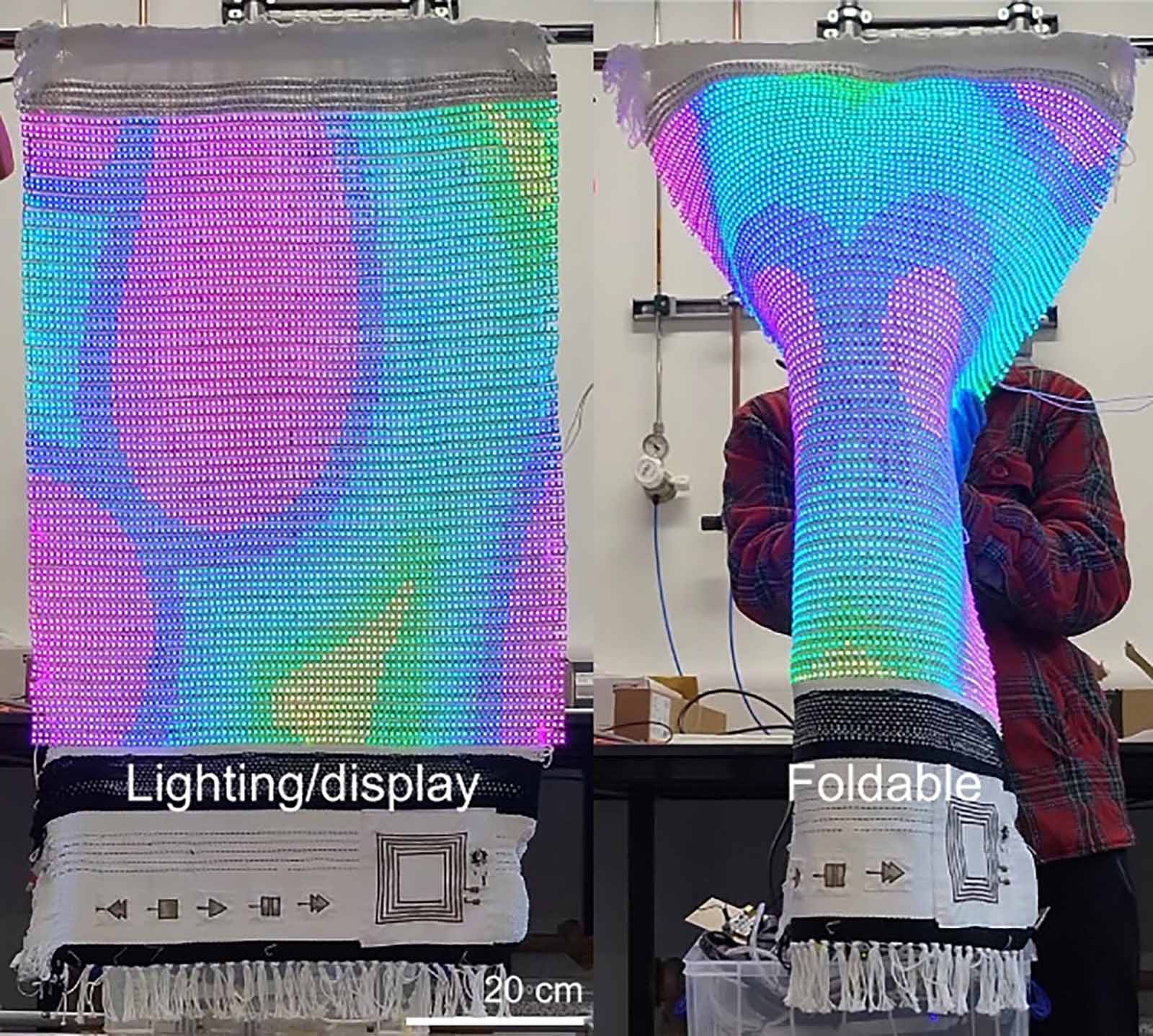
LED curtains for the living room of the future
As a matter of fact, the latest generation of smart fabrics enables energy storage and delivery Photonic features. This means it can emit light.
At the University of Cambridge, UK, they just demonstrated its viability Curtains equivalent to a 46 inch LED TV.
This revolutionary ‘LED curtain’ is perhaps the most complex and innovative technology of all the fibers mentioned in this article. This is because it integrates the ability to display images. A series of sensors and a battery that stores energy.
As such, the curtain incorporates radio frequency antennas, light sensing cells, heat and tactile sensors, among other features. Researchers have achieved this by combining textile fabrics with conductive adhesives, laser welding techniques, and nanotechnology.
The new fibers can be woven on conventional machines, so it would be realistic to start looking. LED curtains or carpets in the coming years.
Innovative (woven) lithium battery
A group of professors and former students at MIT in the US are also advancing the technology. their proposal is A thin wire that integrates all battery componentsThe research has just been published in the scientific journal Materials Today.
The proliferation of wearables has accelerated research into integrating batteries into fabrics. But the battery parts are either bare or have required a few strands of fiber to assemble all the parts so far.
US research team uses 3D printing for breakthrough Integrates all components, including the electrolyte, within the textile fiber.
In the first test they printed 140 meters of new fiber batteryA flexible material that can be used to weave smart clothes. The first version of Fiber offers 123 mAh of storage capacity, enough to charge a mobile phone.
The prototype fiber is only a few microns thick.Researchers believe it is feasible to print thread up to 1 kilometer long using New technology.
Fibers can be printed in solid form, allowing batteries to be incorporated into the system. Objects such as lamps, phone cases, and tablesFor the study, they built the battery into a 3D-printed underwater drone structure. This reduced the weight of the device and increased its autonomy.
solar tent
Finally, China’s counterattack came soon after, in a paper published in the journal Nature Nanotechnology a few months later. The Fudan University team behind the study fiber battery technology It was available even before MIT technology.
The company’s system makes it possible to print cathodes, anodes and electrolytes on sub-millimeter fibers. To do this, they use spinnerets, industrial devices for polymer extrusion.According to the inventor, the system can accommodate this type of fiber up to 250 meters per hour.
The first application of this technology is a smart tent that can accommodate up to 3 people. 550 watts per square meterThe idea is to connect it to a solar panel Store energy for the whole day. LED displays could also be incorporated into these tents if the technology described below is successful.
If you want to know about other fabrics with amazing features, we recommend checking out this new article Wearables that can be monitored user’s vital signs.
sauce: TechXplore, University of Cambridge, https://phys.org/news/2022-02-method-fiber-batteries-industrial-scale.html
