











You may have grown up thinking that cactus spines were there to protect you from predators. However, this is a more widespread myth. Their main function is to retain moisture in plants and protect them from solar radiation. In fact, in milder climates, many cacti have no spines. Thus, the spines block airflow around the plant to prevent evaporation, draw water from the surrounding moisture, and turn to protect the plant from strong sunlight.
With this misconception cleared, let’s move on to a technique developed by Julia R. Greer, director of the Kavli Nanoscience Institute. It is a membrane that evaporates and purifies water during the day and can trap it at night.and thanks for everything Life-inspired or biomimetic designs Based on cactus spines.
draw water out of thin air
Earlier we talked about atmospheric water capture systems. It’s a matter of using condensation from the ambient humidity. New nanomaterials use a series of microstructures that look like Christmas trees when viewed under a microscope. These “microtrees,” as she named them, are hydrophilic structures that attract microscopic water droplets. This design causes these droplets to flow downwards and coalesce into larger droplets. The basic material she uses is a composite called PVA/PPy, a flexible, non-toxic hydrogel.
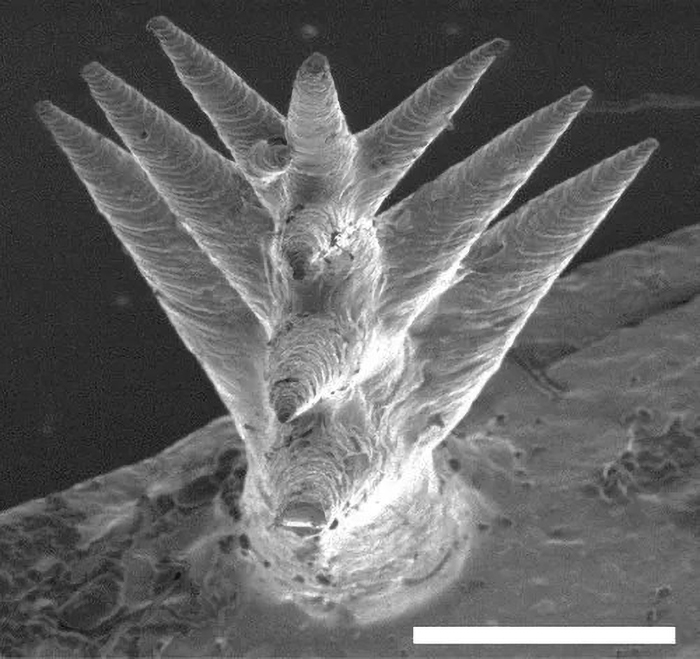
Initially inspired by the morphology of cactus spines, Dr. Greer worked with other researchers to refine the density of the structure. They used a computer modeling system to find the optimal size, shape, and distribution of these nanoforests. In tests conducted overnight using material samples ranging from 55 to 125 square centimeters, it successfully captured up to 35 mm of water from ambient humidity.
water from solar steam
But this innovative technology does more than just trap moisture from the atmosphere. Dr. Greer has managed to integrate different functions into the same device. As is known and can be read here, another technique to obtain fresh water is through solar evaporation. printed.
Throughout the day, the membrane absorbs solar heat and heats the water until it evaporates. Evaporated water condenses on the top cover. At night, the transparent cover is removed to expose the hydrogel. This system allowed us to collect up to 125 mm of water from the solar vapor.
The results are published in Nature Communications under the title All-day Fresh Water Harvesting with Microstructured Hydrogel Membranes.

Water purification and oil spill removal
Condensation of water in the atmosphere isn’t the only idea that cacti have inspired. A few years ago, a group of Chinese researchers repurposed the structure of the spine. In this case, they designed a conical thin copper needle that can separate oil droplets from water. The principle is similar, but in this case the oil microdroplets must be transported to the bottom of the membrane.
This technology project has some similarities to Dr. Greer’s. First, scientists were inspired by how the Opuntia microdasys cactus “harvests” water from the air.Second, they also published this result bio-inspired design at Nature Communications.
These technologies, derived from cactus structures, are another example of biomimetics. This field has produced numerous inventions, from bullet trains that mimic the beak of a kingfisher, to desalination systems based on root behavior, to ultra-hard cement that mimics the exoskeletons of crustaceans and beetles.
sauce: Waterworld, https://www.bbc.com/mundo/noticias/2013/08/130807_ciencia_cactus_puas_biomimesis_limpieza_agua_np
