











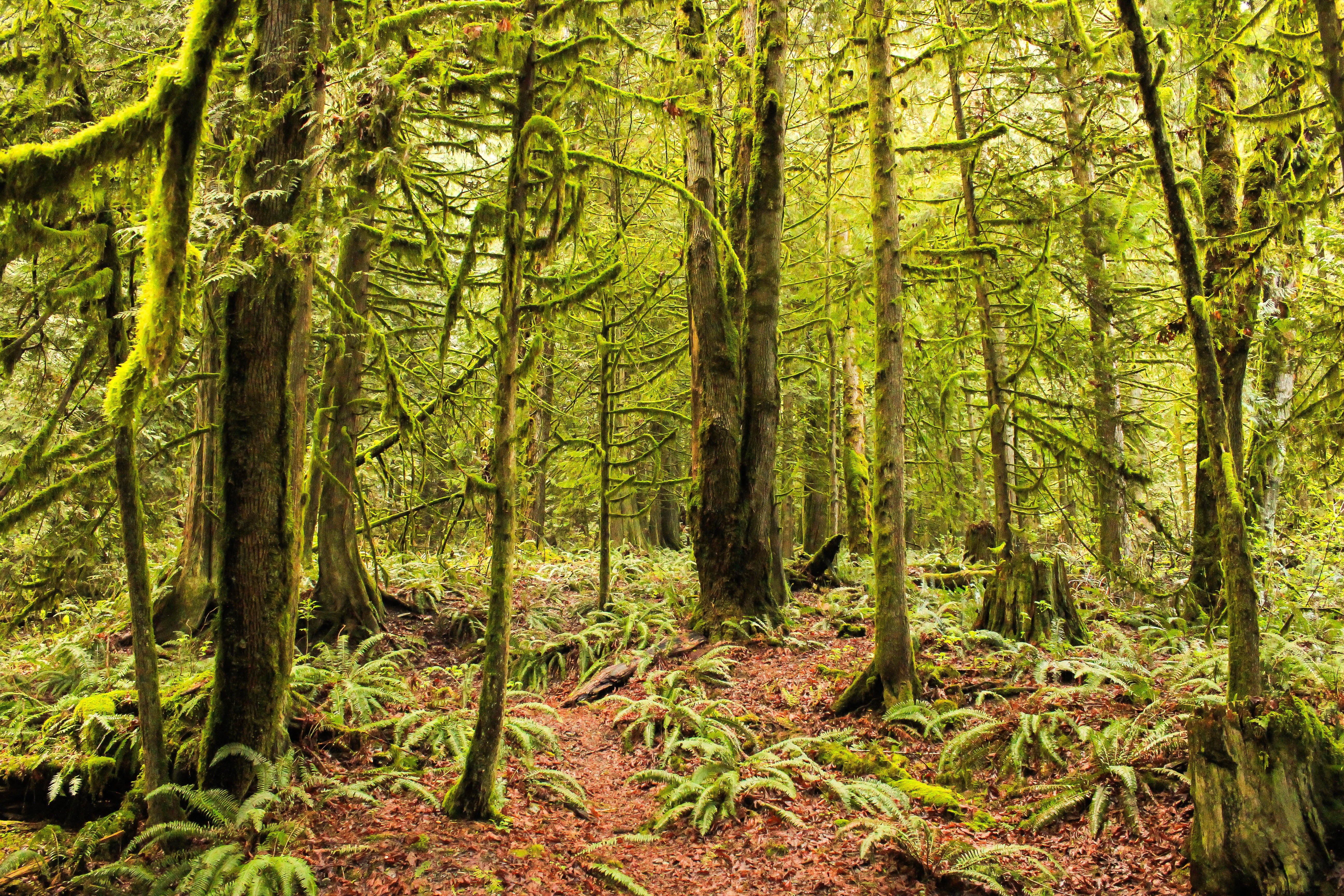
The root tips of the trees are entwined with fungal filaments, forming a hidden underground network that appears to benefit both organisms. A stable source of sugar from trees.
More poetically, research suggests that these connections, known as mycorrhizal networks, can extend between trees, allowing one tree to transfer underground resources to another. Some researchers even claim that trees are cooperating, with older trees passing resources to seedlings, growing them in the same way as their parents.
This idea of forests as supportive and caring places is gaining traction in both scientific literature and popular culture, especially in the 2022 book. In search of the mother tree, in search of the wisdom of the forest Suzanne Simard, a forest ecologist at the University of British Columbia. The phenomenon even has a quirky nickname: the “wood wide web.”
New analysis published in Nature Ecology & Evolution, However, they argue that the evidence for a mycorrhizal network that facilitates tree cooperation is not as strong as the popular story suggests. A relationship between trees and fungi is not non-existent, says co-author Justin Karst, an ecologist who studies mycorrhizal networks at the University of Alberta. Rather, studies with suggestive evidence and many caveats have often been viewed as more definitive than they actually are. No, I just want to reduce the amount of misinformation,” says Karst.
The problem with studying mycorrhizal networks is that they are very delicate. Digging up the roots will destroy the fungi you want to study and the tree web itself. That’s why it’s hard to tell if a particular fungus really ties her two trees together. The best way to circumvent this problem is to sample fungi from different locations, sequence their genetic information, and create a map of where genetically identical fungi grow. This is an enormous amount of work, and she and her co-authors were able to find only five such studies in just two forests, with only two tree species and three fungi, according to the authors. was not possible.
Further complicating these studies is the ephemeral nature of fungal networks. Melanie Jones, a plant biologist at the University of British Columbia and a co-author of the new analysis, says fungi can grow as individuals after dividing. Even genetic samples only provide a snapshot and cannot reveal whether fungal fragments collected on two different trees are actually still connected. They may have been cut by part of the fungus dying or something biting it.
These limitations raise questions about how widespread mycorrhizal networks are and how long they persist.
It is clear that substances from one tree can be absorbed by neighboring trees in the forest. Researchers can test this by providing one of her trees with a compound tagged with a specific marker. In a 2016 study in Swiss forests, researchers sprayed the leaves of some trees with specific isotopes of carbon and found that the isotopes appeared in their unsprayed neighbors. The source of migration is not clear, Jones says. Resources can also move directly from root to root and through the soil, making it very difficult to separate these pathways in real forests. Researchers have attempted to set up barriers between trees to prevent fungal hyphae and roots from connecting them, leaving only soil pathways as a potential means of infection. are made of finer meshes) can themselves affect tree growth, complicating the picture.
To test the effectiveness of mycorrhizal networks, researchers often set up wide mesh barriers that allow fungi to pass through, but not tree roots. However, Karst and Jones argue that in such cases, some researchers rarely confirm that a connected mycorrhizal network actually forms. The strongest evidence for routing resources through the fungal pathway rather than the soil comes from a 2008 study that used mesh to allow only fungi, not roots, and Connecting ponderosa pine saplings to old pines in real forests, says Karst and Jones. The appearance of the dye on seedlings, despite the lack of connections between roots, indicates that the fungal hyphae have undergone migration.
This suggests that trees carry water, says Jones, but questions remain. If mycorrhizal networks have evolved to allow older trees to help their younger relatives survive, resource transfer should improve seedling survival. Some claim to be unstable. “In very well-controlled experiments, less than 20% show better seedling performance,” he says. In the remaining 80% of hers, hyphal-connected seedlings performed as well or worse than those detached from the fungal network, she adds.
On the other hand, the idea that trees provide underground warnings about herbivorous insects and other dangers is based on single greenhouse studies in which Douglas firs and ponderosa pines are connected only by fungal networks. When the researchers stressed the Douglas fir by exposing it to insects, the ponderosa pine also began to excrete protective chemicals. It’s gone. “The main message is that this is not forest-tested,” he says Karst. “If you look at pictures of ancient forests and big trees signaling each other, it hasn’t been tested yet.”
The idea that forests are cooperative rather than competitive also contradicts the basics of natural selection, says Kathryn Flinn, a plant community ecologist at Baldwin Wallace University in Ohio. The argument for cooperation is that healthy forest trees survive better than diseased forest trees, but examples of such groups of natural selection are rare in the wild, says Flynn. , competing for resources in such a way that individual selection favors competition and specific trees thwart group interests. “I think this whole debate is very interesting because it’s an example of people wanting to project their values onto nature, or to see models of human behavior in nature.” says Flynn.
Simard, whose studies on forests have provided much of the basis for the claim that trees cooperate, did not answer specific questions about the new analysis, but said in a statement that she supports her research. “Forests provide vital support for life on Earth. Reducing ecosystems to their individual parts is essential to understanding and appreciating the imperative relationships and behaviors that make these complex ecosystems thrive.” “For decades, compartmentalized approaches have helped explain why forests help regulate global climate and protect such rich biodiversity.” Applying reductionist science to complex systems accelerates the exploitation and degradation of forests around the world.”
Karst, Jones, and co-author of their study, Jason Hoeksema of the University of Mississippi, argue that a reductionist view of forests, in which individual parts of the network are tested individually rather than in context, is the only way to study ecology. Agreed not. But these reductionist studies have been used to make big claims about mycorrhizal networks, they say, adding that they wanted to focus their analysis on what the results really showed. They said they limited themselves to studies conducted in actual forests.
Karst and her colleagues say they are not trying to cool off this area of research, pushing it into new types of forests and encouraging investigation of the most promising areas, such as water transfer between trees. Karst believes that there may still be truth to the idea that mycorrhizal networks are involved in at least some tree-to-tree networks, and better designed experiments could prove that truth. may reach. “I want to do it again,” says Kerst.
