











As the saying goes, “Home is where Wi-Fi automatically connects.” As hard as smartphone makers are touting the next generation of cellular connectivity in their smartphones, many of us spend most of our day connected to the internet via our Wi-Fi.
Wi-Fi is certainly not the first way to wirelessly transfer data between nearby devices. Early PDAs used infrared light, which allowed them to synchronize things like calendar appointments and e-mail inboxes. However, because infrared is directional, I had to point it at the IR adapter and hold still for a few seconds to connect my PDA to my PC. The easiest way to do this was to have both the device and the adapter fixed on my desk. Technically, I didn’t have the wires plugged in, but it made little difference in mobility.
PDAs were one of the first pocket devices to have Wi-Fi connectivity, but they didn’t always come from the factory with that feature. CF and SD cards were used as modular add-ons to enable Wi-Fi, GSM and Bluetooth. and other features.
Not surprisingly, the first mobile device with Wi-Fi was the Windows Mobile PDA. Wi-Fi was able to connect to the Internet (and corporate intranets) and sync emails, calendars, etc. Mainly business related tasks.
Bluetooth is another early local wireless connectivity option. However, it was slower than Wi-Fi (more important for laptops than PDAs, but still) and had less range (at least with commonly available adapters).
Wi-Fi transmit power is limited by law to 100mW, and a rule of thumb is that you can get up to 100m range in ideal conditions (i.e. outdoors with clear line of sight). Interestingly, in 2007, researcher Ermanno Pietrosemoli of He managed to send 3MB of data between the peaks of El Aguila and Platillon in Venezuela, 382km/238mi apart, at a speed of 3Mbps. bottom. Although there are several long-range Wi-Fi connections used today to connect remote areas in the mountains, these are the exceptions.
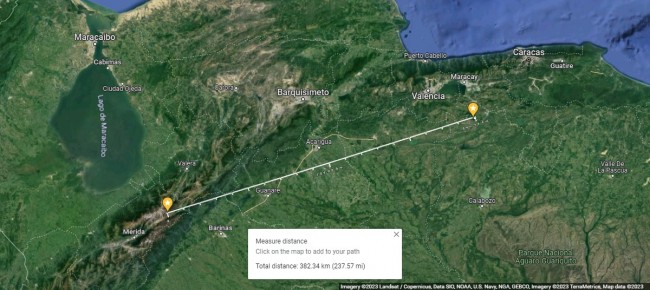
The 382 km connection between the peaks of El Águila and Platillon was established in 2007.
Before we go any further, we need to talk about Wi-Fi naming. First, ‘Wi-Fi’ stands for ‘Wireless Fidelity’ (similar to Hi-Fi), which means ‘IEEE 802.11b Direct Order'”. This technology is part of the IEEE 802.11 family, with versions adding letters (e.g. 802.11b).
But it’s not very catchy, right? So in 2018, the Wi-Fi Alliance changed to a simpler, user-friendly naming scheme. See table below. Note that the 802.11g and earlier names have been retroactively changed. Because “Wi-Fi 4” doesn’t make much sense without them.
| generation | IEEE standard | adoption | Maximum link rate (Mbit/s) | Radio frequency (GHz) |
| Wi-Fi 1 | 802.11b | 1999 | 1 to 11 | 2.4 |
| Wi-Fi 2 | 802.11a | 1999 | 6 to 54 | Five |
| Wi-Fi 3 | 802.11g | 2003 | 6 to 54 | 2.4 |
| Wi-Fi 4 | 802.11n | 2008 | 72 to 600 | 2.4/5 |
| Wi-Fi5 | 802.11ac | 2014 | 433-6,933 | Five |
| Wi-Fi 6 | 802.11ax | 2019 | 574 to 9,608 | 2.4/5 |
| Wi-Fi 6E | 2020 | 6 | ||
| Wi-Fi 7 | 802.11be | 2024 | 1,376 to 46,120 | 2.4/5/6 |
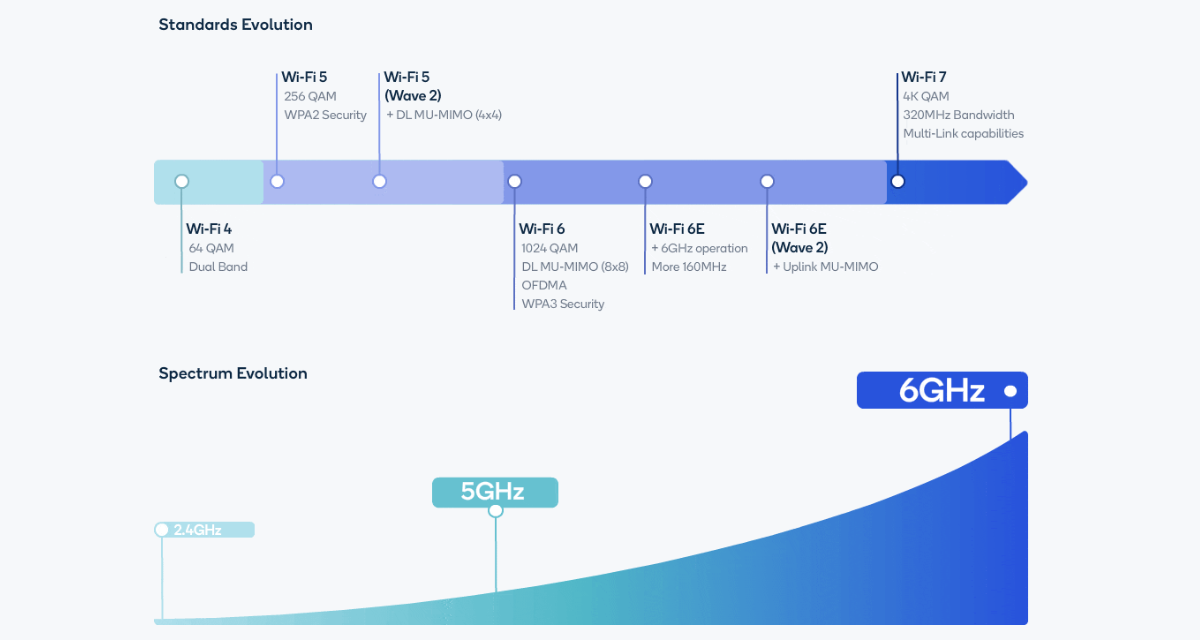
Let’s take a look at some of the major evolutions of Wi-Fi. Early versions operate in the 2.4GHz band, the so-called ISM radio band (ISM stands for Industrial, Scientific, Medical, as it was the band’s early use). This band is fairly loosely regulated, so there are many devices that operate there. Including microwaves, which is at least part of why 2.4GHz is the wireless frontier. Early on, my Wi-Fi and Bluetooth connections were briefly erratic when my microwave started pumping out 1000W of power during lunch. Modern devices are much more resilient (and modern ovens are better insulated).
Wi-Fi 4 (802.11n) is probably the biggest improvement since Wi-Fi’s introduction. Most Wi-Fi before 2008 ran at 2.4GHz, but from the start he had 5GHz support. Wi-Fi 1 (802.11b) ran at 2.4GHz and Wi-Fi 2 (802.11a) at 5GHz. Both standards are from his 1999, but 2.4GHz was the most commonly used band. However, as mentioned, it was very crowded and poor connectivity.
Wi-Fi 4 reintroduced support for the 5 GHz band. It was less crowded and could accommodate larger channels. Initially, the channels on the 2.4GHz band were only 5MHz wide for him, but later he added support for 20MHz channels. But this caused problems. Only four 20Mhz channels can fit in the 2.4GHz band without overlapping (i.e. interfering with each other).
This is why you need to space your Wi-Fi channels. The best channels to choose from are 1, 6, and 11 (there are channels 12 and 13, but they aren’t available everywhere). For comparison, the 5 GHz band has enough room for at least 23 non-overlapping 20 MHz channels.
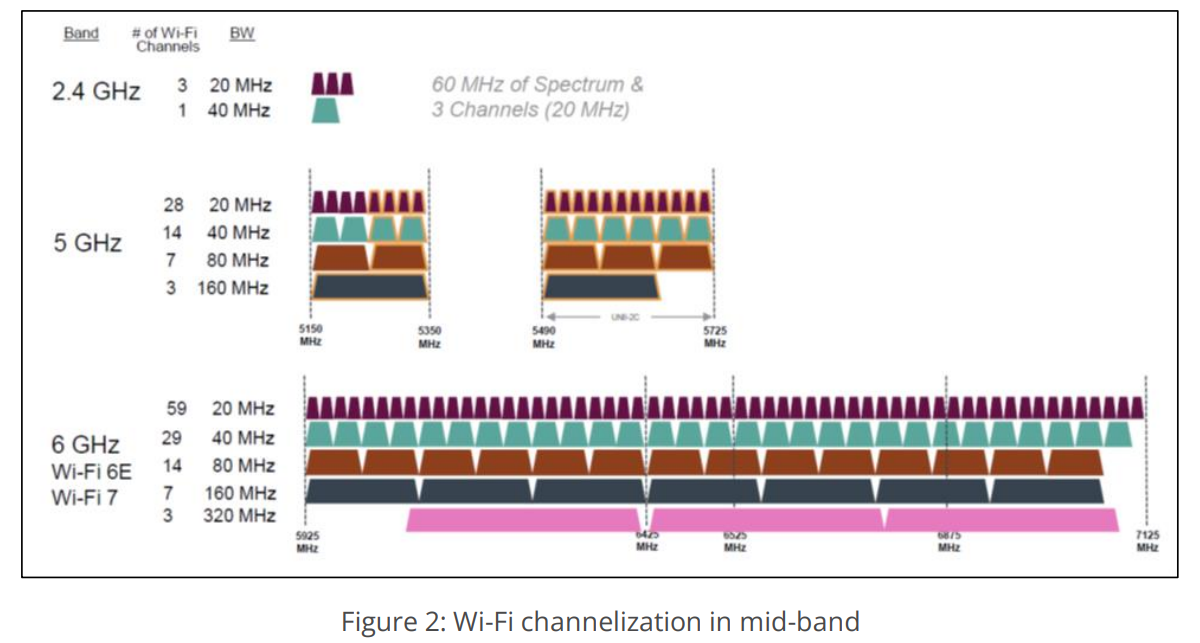
Anyway, Wi-Fi 4 added support for pairing two 20MHz channels to double the speed. Then Wi-Fi added support for 80MHz channels and the ability to combine two channels for a total of 160MHz. Of course, this only worked at 5GHz. Because 160MHz is more than the total bandwidth allocated to Wi-Fi in the 2.4GHz band.
Wi-Fi 4 also introduced support for multiple inputs, multiple outputs, aka MIMO. This allowed the device (both transmitter and receiver) to have multiple antennas, which gave him two big advantages: increased range and speed.
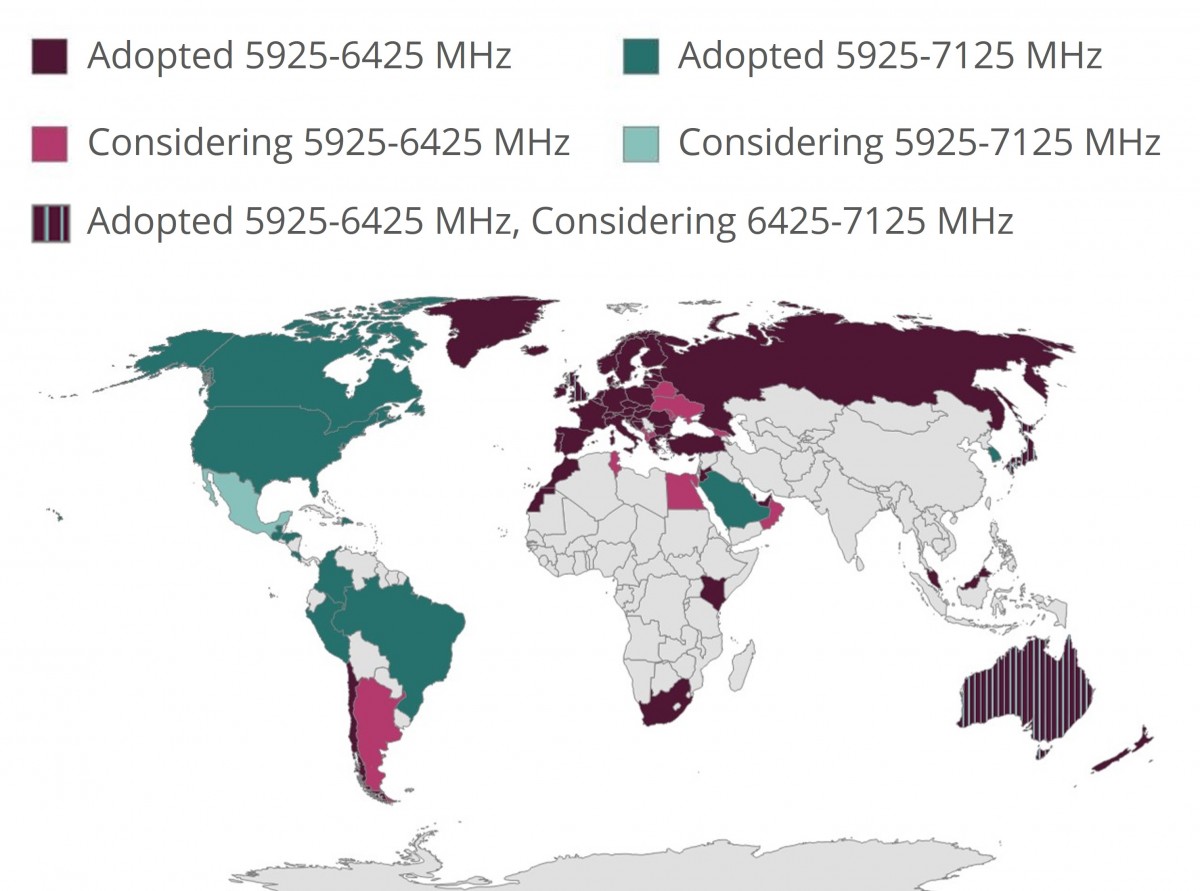
Even the 5GHz band is pretty congested these days, so Wi-Fi 6 moved upstairs to free up the 6GHz band. The technology is called Wi-Fi 6E, and in the US (varies slightly by country), it gives you access to a whopping 1,200 MHz of bandwidth. There’s plenty of room here and the 6E fits seven of his 160MHz channels, but the range is limited compared to the lower frequencies. This is both a blessing and a curse. It helps alleviate congestion, but the smaller range means you either need more access points or build a mesh network.
There’s a lot of cool tech we haven’t covered here. For example, Wi-Fi 6 introduced Targeted Wake Times. This reduces power usage by allowing mobile devices to wake up only when they need to send or receive data, and then quickly go back to sleep.
There’s also the topic of security, from the disastrous WEP to the WPA standard that superseded it. There were also problems with the useful WPS feature (WPS allows users to connect new devices to the network by simply pressing a button on the access point and device).
I didn’t even mention WiGig. The 60GHz standard was seen in some mobile devices as a way to send high-definition, low-latency video to displays without cables. But this article is already quite long, so I’ll leave it for another time.
The most interesting thing on the horizon is Wi-Fi 7. Chip makers like Qualcomm and MediaTek are already gearing up, and we could see the first devices as early as this year. The Snapdragon 8 Gen 2 and some phones with it claim to support Wi-Fi 7, but the standard is still in draft stage and is expected to be completed in 2024. This has been done before, and the first of his Wi-Fi 4 devices also launched based on the draft specification of the standard. Wi-Fi 7 supports 320MHz bandwidth and speeds up to 30Gbps.
Do your phone and home access point support the latest Wi-Fi version? And is that what you care about or are you happy with using the older version? mosquito?
