











Effectively, these bots are built in segments, each with its own multicopter propulsion unit that can vector thrust in any direction thanks to a multi-axis gimbal system. Although the segments are connected, they can be articulated in different directions. The team has figured out how to adjust all these propulsion systems in real time, even as the structure shifts shape during flight. The concept was originally inspired by the idea of flying dragons and the way these mythical beasts wriggle their bodies smoothly through the air.
“When I was a kid, I was from China, so I always dreamed of dragons,” says Moju Zhao, project leader and assistant professor. “There are a lot of biologically inspired robots. People make robot dogs and robot cats. Dragons are not real animals, but they are like sacred symbols in Asia. Fly this robot Imagine a human arm, you can change lamps, you can open doors like a human arm, you can also think that this robot can transform like a snake. You can explore tight spaces very quickly.”
You can see the team’s “Dragon” robot in action in the video below. It’s a little wobbly and a little slow, but very impressive given the complexity involved in controlling a multi-rotor aircraft that constantly changes its structural shape and orientation. and rolled itself up to create a flying gripper ring capable of grasping, compensating, manipulating, and releasing objects weighing up to 1 kg (2.2 lbs). increase.
General-Purpose Articulated Aerial Robot DRAGON: Aerial Manipulation and Grasping with Vectorizable Thrust
It’s a pretty amazing idea, sort of like a flying claw that can meander through an area and grab things and do useful tasks with them. Another video shows the dragon using pin-like attachments to open and close a large valve upwards, downwards, and horizontally.
SPIDAR: A Spherically Vectorizable, Distributed Rotor-Assisted Airborne Amphibious Quadruped Robot
The team has been working on Dragon for years, and as flight control software gets faster and starts moving faster and smoother, it’s easy to see the potential of such a highly flexible aerial platform.
This time, the team has presented an even stranger concept in the form of a new “SPIDAR” robot. It’s an awkward acronym for “SPherIcally vectorable and Distributedroters assisted Air-ground Amphibious Quadruped Robot.”
SPIDAR is a quadruped robot with multiple joints at the hip and knee joints of each leg. These joints are not motorized to aid movement, but the team minimized extra motors by using vectorized multicopter propulsion units in each segment as the primary means of moving the legs. I tried to keep it down. Structure in the air.
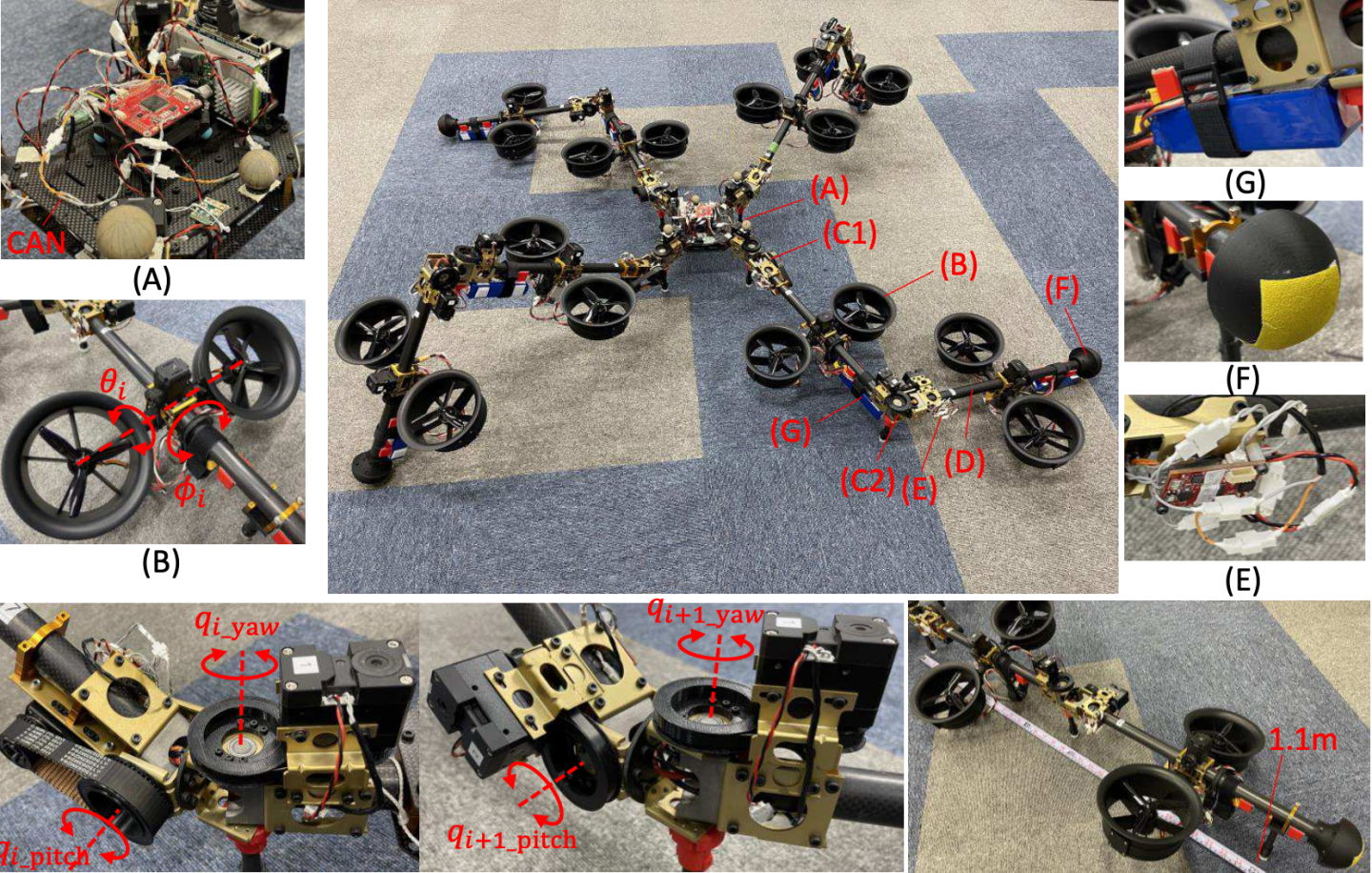
Moju Zhao / The University of Tokyo
The end result is a very slow and noisy spider robot, as the video below shows. It also seems to work hard to stay airborne, as harmonic oscillations between propulsion units are clearly an issue. The walking action seems a bit pointless, you can walk for 20 minutes or fly for 9 minutes with your current battery settings.
But it still brings up some very cool possibilities. With a little more development, this could become a four-point flying claw gripper, allowing him to hold and manipulate two objects at once. For example, take off the lid of a jar or hold a box to pick up something and put it in the box.
SPIDAR: A Spherically Vectorizable, Distributed Rotor-Assisted Airborne Amphibious Quadruped Robot
Obviously these are very early prototypes. But with a little imagination, you can see how these develop into: matrixA flying squid robot styled with as many arms as practical. The arms are not the body’s own weight, as each tentacle or leg segment has a propulsion unit. Each is a support and can provide lift with varying degrees of leverage depending on where the load is. Such machines can perform multiple tasks at once, locking free “arms” to support structures against walls, ceilings, floors, or other rigid objects that require extra force or leverage. There is a possibility.
It’s a fascinating concept and has the potential to create remarkable and useful flying robots with features and shapes never actually seen in nature. They were mythological and sci-fi material. It is very beautiful.
A paper on the Spidar robot is available here.
Source: Moju Zhao/University of Tokyo via IEEE Spectrum
