











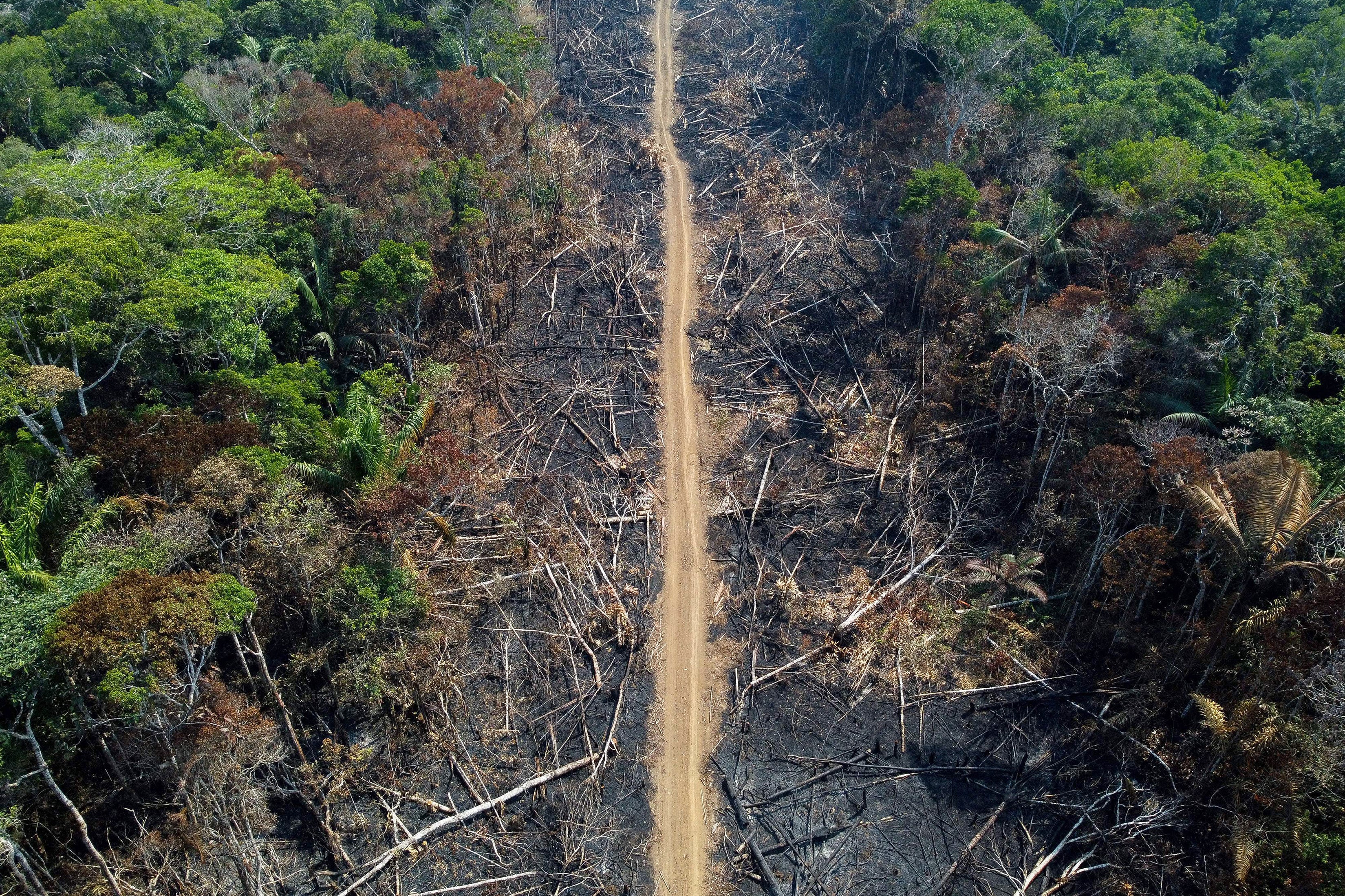
From the air, the South American Amazon is a lush emerald quilt, home to millions of animals and the largest river on earth. It is also the key to protecting the planet from the adverse effects of climate change.
but why? What would happen to the Earth’s climate if we lost it?
At nearly 7 million square kilometers, or an area the size of Australia, the vast Amazon shines brightly on the climate change arena. With so many trees covering vast tracts of land, everything the forest “does” is big and impactful. Some of its behavior is truly unique. The Amazon creates its own weather, generating part of the rainfall, keeping itself cool, while also stabilizing regional temperatures. But we are steadily dismantling this precious landscape, exacerbating climate change in some ways that scientists are beginning to understand.
giant carbon sponge
All forests on Earth affect the atmosphere. Trees absorb carbon dioxide from the atmosphere through photosynthesis and trap that greenhouse gas in their leaves, trunks, roots, and nearby soil. The vast amount of trees in the Amazon make it one of the world’s largest carbon sinks. Carlos Nobre, an earth system scientist at the University of São Paulo in Brazil and a long-time researcher on the impacts of the Amazon on climate and ecosystems, says, “Today’s Amazon is more than 150 billion tonnes, despite all deforestation. of carbon is stored.” deforestation. About half of the Amazon’s carbon stores are in underground soil. The other half is in trees, containing about 20% of the total carbon absorbed by vegetation on the planet.
However, when humans cut down these trees, their biomass releases the accumulated carbon into the atmosphere as CO.2, has a warming effect. Like other greenhouse gases, carbon dioxide molecules prevent heat from the earth from escaping into space. Agriculture and mining are steadily deforesting the Amazon’s dense network of 16,000 tree species. Overall, deforestation has lost 17% of his rainforest tree cover since 1970.
The logging industry often sets fires and clears out areas. This rapidly releases stored carbon into the atmosphere. Any wood left unburned will decompose and release carbon.Fires help explain why parts of the Amazon forest are now emitting more CO2 Than they absorb. Fires also produce soot that blocks sunlight and contributes to warming.
make it rain
Warm air returns to the forest. With global warming, drought-related weather events are becoming more frequent and severe in South America, said Nobre, who is also co-chair of the Amazon Science Panel, which supports research and initiatives to save the rainforest. says. This impact has resulted in longer dry seasons, less rainfall and increased tree death in the region. Dryness and loss of forest cover also increase the risk of wildfires.
Nobre says the loss of trees has other consequences. During the dry season, the sun is stronger and a lot of water (water stored in trees and soil from the rainy season) is released. That water vapor “reaches the lower atmosphere and becomes clouds and rain again,” Nobre explains. “Every single he molecule of water vapor that enters the Amazon is recycled five to eight times,” he adds, demonstrating the importance of this hydraulic engine in recharging the region’s rainfall. Just as rainfall in sufficient quantity can have a cooling effect on your body by making you sweat after exercise, it also has a cooling effect.
As tree cover is reduced, more water is stored and with it more forest. Previous research, led by Nobre, suggests that cycles of warming, drying and shrinking forests could push tree cover in the Amazon to a minimum threshold, below which forests would degenerate into simpler grassland habitats. It has been shown that it can degrade irreversibly.
What if the forest is gone?
Exact estimates vary as to where that threshold is. Nobre et al. suggest that only 20% to 25% of pre-deforestation tree cover in the Amazon could be lost (bearing in mind that the forest has already lost 17%). . There are also different numbers for how fast a forest degrades once a threshold is exceeded. But parts of the southern Amazon are already transitioning into what Nobre describes as “an open canopy of degraded ecosystems.” This is a sparsely tree-covered landscape that has “greatly reduced biodiversity,” Nobre says, so that it stores only a fraction of the carbon of the pristine rainforest.
When forests decline and their trees release massive carbon stores, what does that mean for the Earth’s climate?
The Amazon’s estimated carbon bank of more than 150 billion tons equals more than a decade’s worth of global fossil fuel emissions, Nobre says. If the entire Amazon were to degrade to open savanna-like landscapes, rainfall in the region would decrease by up to 30%, reaching even Colombia and Argentina, where the rainfall cycle is partially supplied by moisture from the Amazon. He explains Nobre. Without the surface cooling effect of forests, local temperatures would rise by several degrees.
The loss of forests will reverberate around the world. “If you put [carbon dioxide] It spreads rapidly in the atmosphere and spreads around the world,” says Elena Sheblikova, a physical scientist at the Institute for Geophysical Fluid Dynamics, part of the National Oceanic and Atmospheric Administration.For example, releasing 120 billion tons of CO2 (A more conservative estimate of the Amazon’s carbon stocks.) By cutting down the forest, she explains, the planet warms by just 0.25 degrees Celsius.
Even if the world cuts enough anthropogenic emissions to keep global warming below 1.5°C above pre-industrial levels and get on track to implement the Paris Agreement, the Amazon A sudden loss of that carbon would make that goal unattainable. arrival. Shevliakova said there should be concern about the impact of Amazon degradation, as global emissions reductions are currently falling short of targets.
To protect this planetary gem, the international community urgently needs to curb deforestation and greenhouse gas emissions, and replant degraded lands where possible, says Nobre. Saving the Amazon is also intertwined with indigenous rights. A growing body of research suggests that land managed by indigenous peoples experiences less deforestation.
The Emerald Biome may seem faraway, but everyone on Earth is connected to its destiny, says Shevliakova. “Losing Amazon will affect everyone.”
