











“Standards documents have become a very important source of wireless SEP prior art and should be comprehensively reviewed to confirm/challenge SEP validity.”
 Technical standards play a vital role in our lives. Wireless standards such as 5G are revolutionizing the mobile industry with unprecedented user experiences for both voice and data. Moreover, these standards are also having a major impact on the future of various industries such as automotive, healthcare, smart homes, smart cities, smart grids, smart manufacturing, AR/VR, and more.
We often hear the term “standard-essential patents” for the intellectual property rights of the technology that develops such standards. Simply put, a standard-essential patent (SEP) is a patent that claims technology that is necessary and unavoidable for the implementation of a standard. SEP licenses are generally based on FRAND (Fair, Reasonable, and Non-Discriminatory) terms.
Prior art point of view
Not all patents granted are valid over prior art. During prosecution of a filed patent application, patent office examiners will search and review prior art relevant to the submitted claims as defined by the applicable law of their jurisdiction. However, for various reasons (difficulty in accessing sources, examiner workload), the prior art search during examination may not be comprehensive.
That is why it is so important to check the validity of SEP claims against the prior art. Prior art laws vary by jurisdiction.But across all jurisdictions, the question is “Are the patent claims more valid than the prior art?” is as important as “Do the patent claims read the standard?”.
Standards documentation as prior art and related issues
In this regard, standards documents from online sources maintained by standards-setting organizations (SSOs) are usually an important source of relevant prior art. Such prior art includes technical specifications, technical reports, change requests, communication statements, work item descriptions, research documents, recommendations, and RFCs.
However, accessing this documentation available on the SSO website is often not straightforward. Some of the challenges faced by prior art researchers are listed below.
- Unlike patent data, standard documents are either unstructured or semi-structured data. The scope of the structure varies from SSO to SSO and from document type within a particular SSO. For example, ITU-T Recommendations have a relatively structured format compared to ITU-T technical reports and papers. IEEE research documents, on the other hand, have a very unstructured format. This is in stark contrast to patent data available to prior art researchers in a highly structured format, with well-defined data such as abstracts, claims, background, citations, and various date-related fields. There are fields.
- The interface for accessing standard documents is different for each SSO.
- Overall, the SSO website’s search interface is not designed for structured prior art searches.
Determining the Importance of Standard Documents as Prior Art for Standard Essential Patents
A review of prior art within patent publication data can be more structured and efficient, but cannot supplement a review of standard documents. The above may say the obvious, but it should be called out. In fact, SSO members do not necessarily file patent applications for every contribution or change request they submit towards the development of standards. Such content is therefore not included in the patent data. Also, be aware that published patent data may not be up-to-date as it can take 18 months or more from filing to publication. So, during prosecution of a potential SEP, standard documents may prove to be a “newer” source of prior art compared to patent data, but comprehensively It may not be reviewed.
Below we consider the importance of standards documents as prior art to standard essential patents (SEPs) for wireless communication standards such as 4G, 5G and the IEEE 802.11 standard. A statistical analysis on a sample set of European Patent Office (EPO) objections on SEP was used to examine the impact of standard documents. Also, using Wi-Fi 7 (IEEE 802.11be) as an example, and analyzing the data contributed to this intent, we have found that SEP is prior art from other standard-setting organizations (other than those with which SEP is associated). It also addresses document relevance.
What impact do standard documents have on SEPs in post-grant proceedings?
To answer this question, we conducted a statistical study of European oppositions filed against patents relating to wireless communication technology. Key findings are described below.
Approach to analysis
- For our research, we have selected a sample set of 60 oppositions submitted to the EPO and meeting the following criteria:
- Target patents are related to wireless standards (mainly 3GPP, IEEE standards)
- Opposition procedure closed/completed
- The subject patent was revoked (26 cases) or the independent claim of the subject patent was amended (34 cases)
- In each of these 60 cases, the Opposition Division determined whether standard documents were cited as prior art to amend the independent claims/revoke the subject patent.
- If yes, were the standard documents cited as prior art according to Article 54 or were all standard documents cited as prior art according to Article 56 EPC?
Takeaway
- For the 26 “cancelled” cases:

Figure 1
-
- In 13 canceled cases, the cited standard-related documents were confirmed by the Opposition Division as prior art in contesting the validity of independent claims (9 under Article 54, 4 under Article 56). .The cited standard documents directly contributed to the final result that the subject patent was revoked
- Of the remaining 13 revocation cases, the Opposition Division relied on prior art other than standard documents for revocation of the patent in only two cases (one prior patent art, one non-standard non-patent literature). otherwise). The remaining 11 cases were cases in which the subject patents were revoked for reasons unrelated to prior art. Examples of such grounds are Article 100(b) EPC (“The patent does not disclose the invention in a sufficiently clear and complete manner…”) and section 100(c) (“The subject matter of the European patent goes beyond the content of the filed application…”)
- Regarding the 34 “fixed” cases:
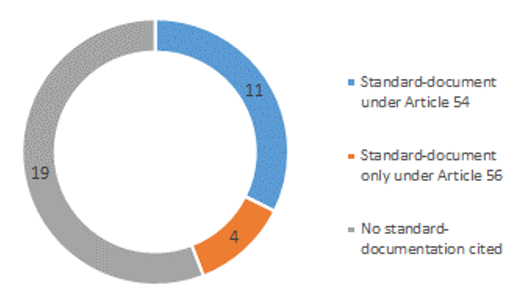
Figure 2
-
- In 15 amendment cases, the cited standard documents were identified by the Opposition Division as prior art challenging the validity of an independent claim (11 under Article 54, 4 under Article 56). compliant).The standard documents cited contributed directly to the final outcome of the amended claims
- Of the remaining 19 “amended” cases, only three had their claims amended to overcome the published prior art. The remaining 16 cases were cases in which the claims were amended to overcome objections unrelated to the prior art, such as Articles 100(b) and 100(c) EPC.
This analysis underscores the reliance primarily on standards documents when challenging the validity of SEPs given to wireless standards at the EPO. In other words, standard documents may not have been comprehensively considered by assignees and examiners during prosecution of the subject patent. This observation can be speculated as suggesting that standards documents have become a very important source of prior art for wireless SEPs and should be comprehensively reviewed to confirm/challenge the validity of SEPs. .
Are other SSO standard documents also relevant?
To address this, we conducted an extensive level analysis of contributions to Wi-Fi 7 (IEEE 802.11be) and their citations. The IEEE 802.11be amendment is currently under development and will be released in 2024.
Approach to analysis
The IEEE Mentor web page provides access to a wealth of documentation categorized according to IEEE working groups. Within this data, the research documents constitute the primary documentation of the technical contributions made towards the development of standards in each working group.
Therefore, for analysis purposes, we have retrieved all research papers published in Task Groups, Topic Interest Groups and Research Groups (TGbe and EHT TIG/SG) related to Wi-Fi 7 by the end of 2022. [inactive]). Additionally, we took and normalized the citation data for this Wi-Fi 7 research documents dataset (the documents cited in each research document).
Takeaway
Key stats:
- After deduplication (multiple versions of the same document), 1,343 research documents I got something related to Wi-Fi 7
- Within this dataset, 1,634 unique documents cited
- In total, these 1,634 documents were 5,324 total citations in the dataset
- The SSO distribution of the 1,634 citation documents is:
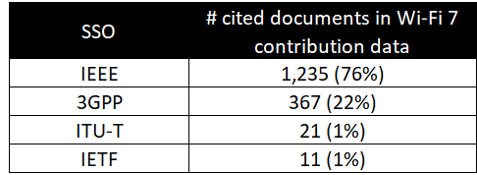

22% of the uniquely cited documents were from 3GPP cited by 153 Wi-Fi 7 research documents (11% of the total dataset of research documents). This shows a strong correlation between Wi-Fi 7 technology and that of 3GPP, with many physical and MAC layer technologies significantly better at delivering Wi-Fi 7 performance improvements than previous versions. Not surprising, because it matters. Already considered or incorporated into the 3GPP standard. Our dataset also shows that 153 research documents, citing 3GPP documents, mainly discuss techniques such as his MU-MIMO, QAM, link adaptation, and retransmission protocols such as HARQ. confirmed. These duplicate the work done at 3GPP. In general, it is said that there is overlap in the technologies deployed in multiple wireless standards because the fundamental building blocks of communications apply to all standards and the selection of technologies for such building blocks is state-aligned. It is no exaggeration to say that – State-of-the-art technology during standard development.
With respect to prior art, this strongly suggests that the contested prior art may come from any standard document and is not limited to the standard to which the SEPs in question are concerned.
call to action
In conclusion, we would like to emphasize that documents from SSO sources are a relatively untapped commodity in prior art research on SEPs, especially at the prosecution stage. Done well, this can go a long way in helping the patent assignee create a stronger his SEP portfolio and avoid complications later on. It also helps parties involved in licensing, litigation, challenges, inter partes reviews and acquisitions to comprehensively confirm/challenge the validity of a claimed SEP or SEP of interest. The future of SEP licensing and litigation awaits!
Image Source: Deposit Photo
Image ID: 461117330
Author: Diloka107
