











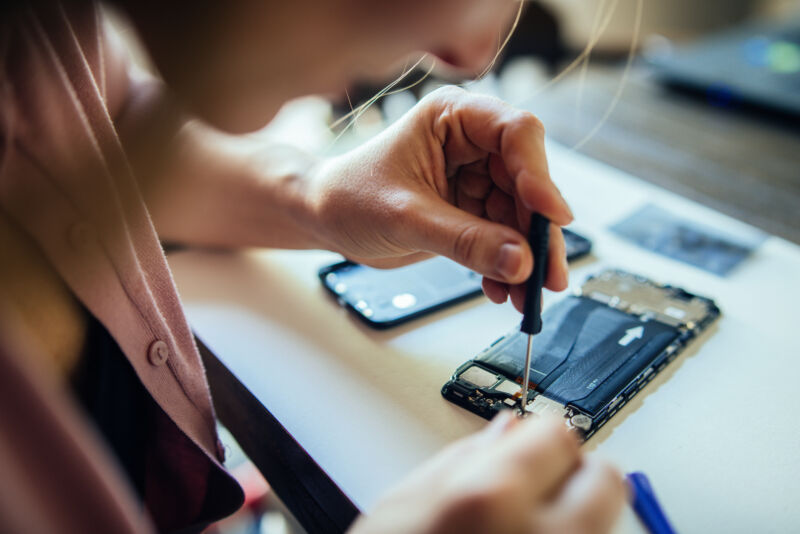
Manufacturers of various product categories, such as TVs, vacuum cleaners, smartphones, and tablets, may require their products to be repairable for up to 10 years after purchase, depending on the type of device. The European Commission announced Wednesday that it has adopted a proposal to implement long-term repair requirements for electronics manufacturers if approved by the European Parliament and the Council.
The regulation applies to all devices requiring repairability within the EU, such as vacuum cleaners, washer-dryers, welding equipment, servers and data storage devices. The EU is currently rolling out right-to-repair requirements for smartphones and tablets.
The EU already requires vendors to repair or replace products free of charge within two years of purchase if the product is defective. The new regulations require companies to offer free repairs (instead of replacing products) if doing so is the same price or cheaper than replacement.
Additionally, the proposed law would require vendors to provide repairs for a minimum of five to ten years after purchase, depending on the type of device. For example, a television manufacturer will require him to repair for at least seven years after purchase, and a washing machine and washer-dryer manufacturer will require him to repair for ten years. The EU is now considering a proposal under the proposed law on Wednesday that would require smartphone and tablet makers to provide repairs for up to five years.
The regulation does not require vendors to make repairs within this time if it is “impossible”, such as “repair is technically impossible”, the commission explains on its Q&A page.
The Commission estimates that over 15 years, the regulation will save 18.5 million tons of greenhouse gas emissions, 1.8 million tons of resources and 3 million tons of waste. Meanwhile, EU consumers will save €176.5 billion (about $192.3 billion), while “sellers and producers” will save about €15.6 billion (about $16.3 billion), according to the commission’s measures. .
Make repairs more attractive
One of the driving forces behind the proposal is to boost the repair sector, and the commission argues that employment will increase if the regulation is passed. However, it did not provide an estimate for the number of new jobs.
A committee statement on Wednesday said:
Over the past few decades, replacement has often been prioritized over repair when a product becomes defective, and consumers have had little incentive to repair goods when their legal warranty has expired. bottom. This proposal makes it easier and more cost-effective for consumers to repair goods rather than replace them.
The proposal also calls on European Union Member States to establish an “online matchmaking repair platform to connect consumers with local repair and refurbished goods sellers”. Businesses must also speak up and inform customers of their repair obligations and services, including providing repair price and time estimates upon request.
The commission wants to establish a “European quality standard for repair services” to help consumers find “better quality” repair shops. The standard is “open to all repairers throughout the EU who are willing to commit to minimum quality standards, for example based on product duration or availability”.
ongoing discussion
The European Right to Repair Coalition issued a statement on Wednesday, arguing that the commission’s proposal “doesn’t address the cost of repairs” or is not sufficient to empower independent repair shops. It promotes laws that ensure the use of second-hand spare parts and universal access to affordable spare parts, repair manuals and diagnostic tools, as well as financial incentives to reduce the price of repairs.
The Coalition believes that vendors must repair devices within two years of purchase, regardless of whether it is cheaper than replacing the vendor’s item. We also hope that the proposal will influence more product categories.
The commission acknowledged that consumers are sometimes deterred by the cost of repairs, and said part of its proposal is to make repairs a more attractive option for consumers with broken gadgets. says. But instead of regulating things like spare parts and pricing, the ecodesign directive relies on hardware manufacturers to build designs that are easier to repair.
At a press conference reported by TechCrunch yesterday, Didier Reynders, one of the commission’s judiciary members, pointed out the importance of repairable designs to reduce repair costs.
“This means that repair costs can be significantly reduced. No, so an ecodesign approach should simplify things there.”
Cecilia Bonefeld-Dahl, executive director of tech industry group DigitalEurope, has given up some control over the repair of purchased gadgets, despite the commission’s claims that its proposal could help local repair shops. He hinted at the industry’s early reluctance to do so.
