











The James Webb Space Telescope (JWST) captured a stunning image of Uranus, showing the ice giant’s ring system, brightest moon, and dynamic atmosphere in great detail.
The new observations, made on February 6, follow JWST’s recent equally stunning picture of Neptune, another ice giant of the Solar System.
A new image of Uranus shows 11 of the planet’s 13 known rings, some of which are so bright that they are somewhat mixed up. But what really surprises astronomers is the fact that JWST’s near-infrared camera (NIRCam) instrument is sensitive enough to capture the innermost two of Uranus’ dust rings.
These faint rings have only been glimpsed by two astronomical eyes: the Voyager 2 spacecraft, which passed Uranus in 1986, and more recently, the Keck Observatory’s Advanced Adaptive Optics system.
When Voyager 2 imaged Uranus during its 1986 flyby, it was little more than an inert blue marble devoid of distinct features. This new JWST photo of him is in stark contrast, depicting a dynamic and changing world.
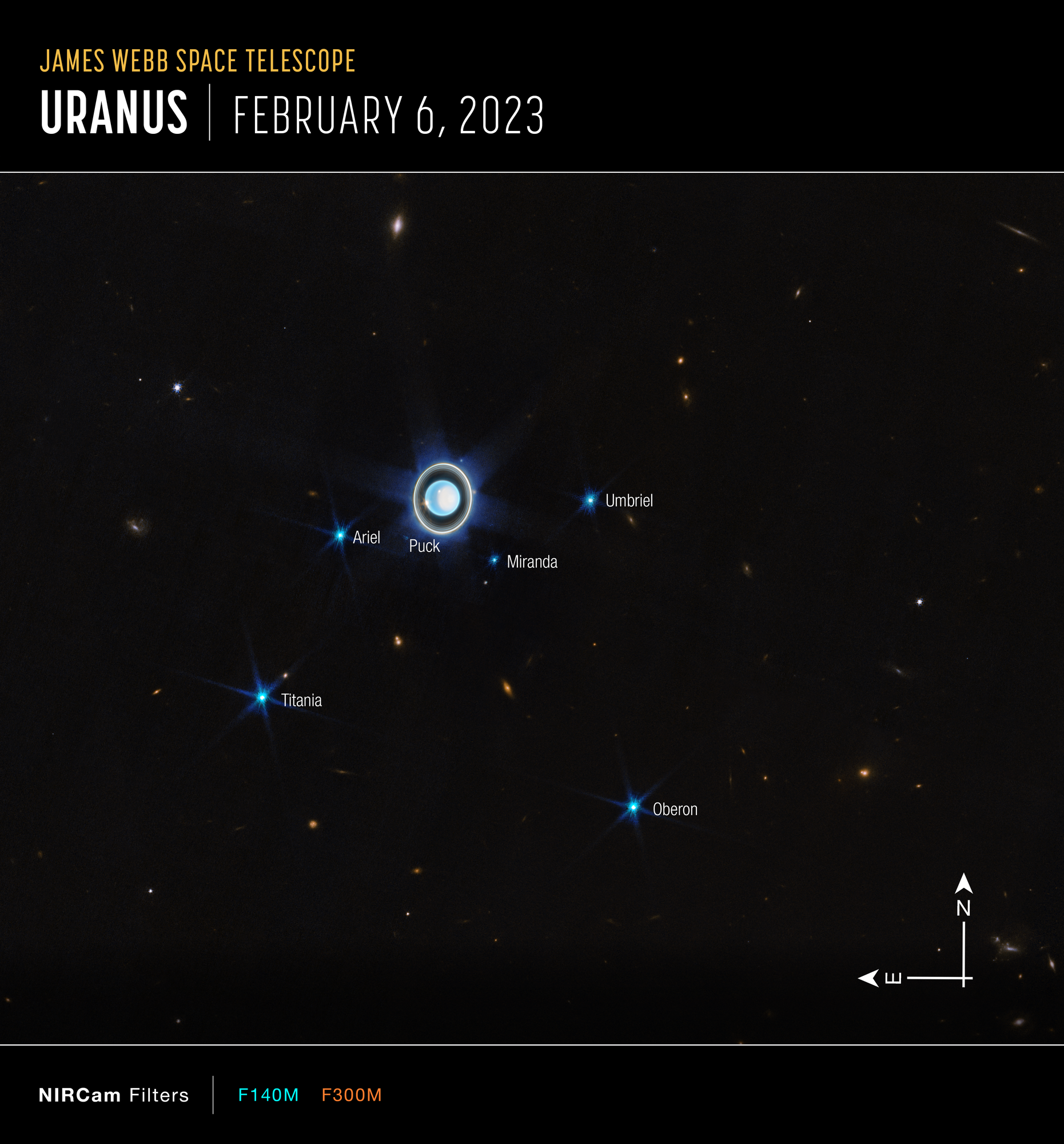
The JWST image was created by combining data from two filters, shown as blue and orange highlights, respectively. A representative color image shows dense icy liquids of water, methane, and ammonia above the core of tiny rocks that make up Uranus, which looks like a light blue snowball.
Uranus has its own orbit in the solar system, with the ice giant rotating sideways and tilted at an angle of about 90 degrees to its orbit around the sun. This tilt causes Uranus to experience extreme seasons, with each pole exposed to constant sunlight for years before falling into similarly long periods of darkness.
It is currently spring at the North Pole of Uranus. This can be seen in the image, brightening to the right of the ice giant with the Arctic ice cap facing the Sun. This is the first time scientists have seen this side of the polar cap. It’s also missing from the latest images captured by Keck.
There are bright clouds at the edges of the polar caps, and some faint extensions are nearly visible. This includes his second very bright cloud to the far left of Uranus. Such clouds are typical of Uranus and can be seen at infrared wavelengths. They are theorized to be related to storm activity across the ice giant, according to members of the JWST team, with Uranus’ north pole summering from his 2028.
Uranus’ South Pole is now on the planet’s dark side, invisible in images, heading away from the Sun into pitch-black space.
JWST has successfully spotted 6 of Uranus’ 27 known moons. These are the brightest months. Others are too faint to be seen in a relatively short 12 minute exposure.
Powerful space telescopes continue to observe the ice giant. Mission team members are expected to get a glimpse of two even darker outer dust rings discovered by the Hubble Space Telescope in 2007.
Copyright 2023 Space.com, a company of the future. all rights reserved. This material may not be published, broadcast, rewritten or redistributed.
