











A new shape has been discovered that makes for a very unique set of bathroom tiles. Nicknamed “The Hat,” his 13-sided shape can tessellate by itself without repeating patterns, solving a 60-year-old mathematical mystery.
This very niche milestone is made possible by David Smith, a self-professed tile enthusiast from Yorkshire, UK. Like many others in the community, Smith was looking for a specific kind of shape called an aperiodic monotile or “Einstein”. Its name has nothing to do with the famous physicist, but is a combination of the German words ein (meaning one) and stein (meaning stone).
This “one stone” is a formerly imaginary shape that can tile planes without overlaps or gaps, never repeating the same pattern even if it is stretched into infinite space. , cannot be physically repeated. Smith’s hat is the first such shape found to fit the bill.
It may not sound like much to many, but mathematicians have been looking for puzzle pieces with these properties since the mid-1960s. That’s when the first set of shapes was discovered that showed aperiodic (non-repeating) tiling, but the toolbox needed over 20,000 different shapes to keep the pattern from repeating. was. Further work over the next decade saw that number grow smaller and smaller until Sir Roger Penrose reduced it to just two, forming what is now known as the Penrose His Tiling.
“These two shapes of the Penrose solution had enough structure to prevent periodicity,” said Professor Craig Kaplan, a researcher on the study describing the new shape. “But for almost 50 years mathematicians have wondered: Can we get to just one shape? Can we do this with monotiles? That’s the problem we solved. I found a single shape that does what all these previous sets of multiple shapes can do.”
Smith initially experimented with paper cutouts of shapes, but there are only so many that can be tested on a finite plane. To confirm the hat’s special ability, he contacted Kaplan, who had recently developed software that could check certain shapes on a larger scale. For example, he can identify all the different ways shapes can be placed in small groups or “neighborhoods” and determine if these can exist in a larger tiling without breaking the rules.
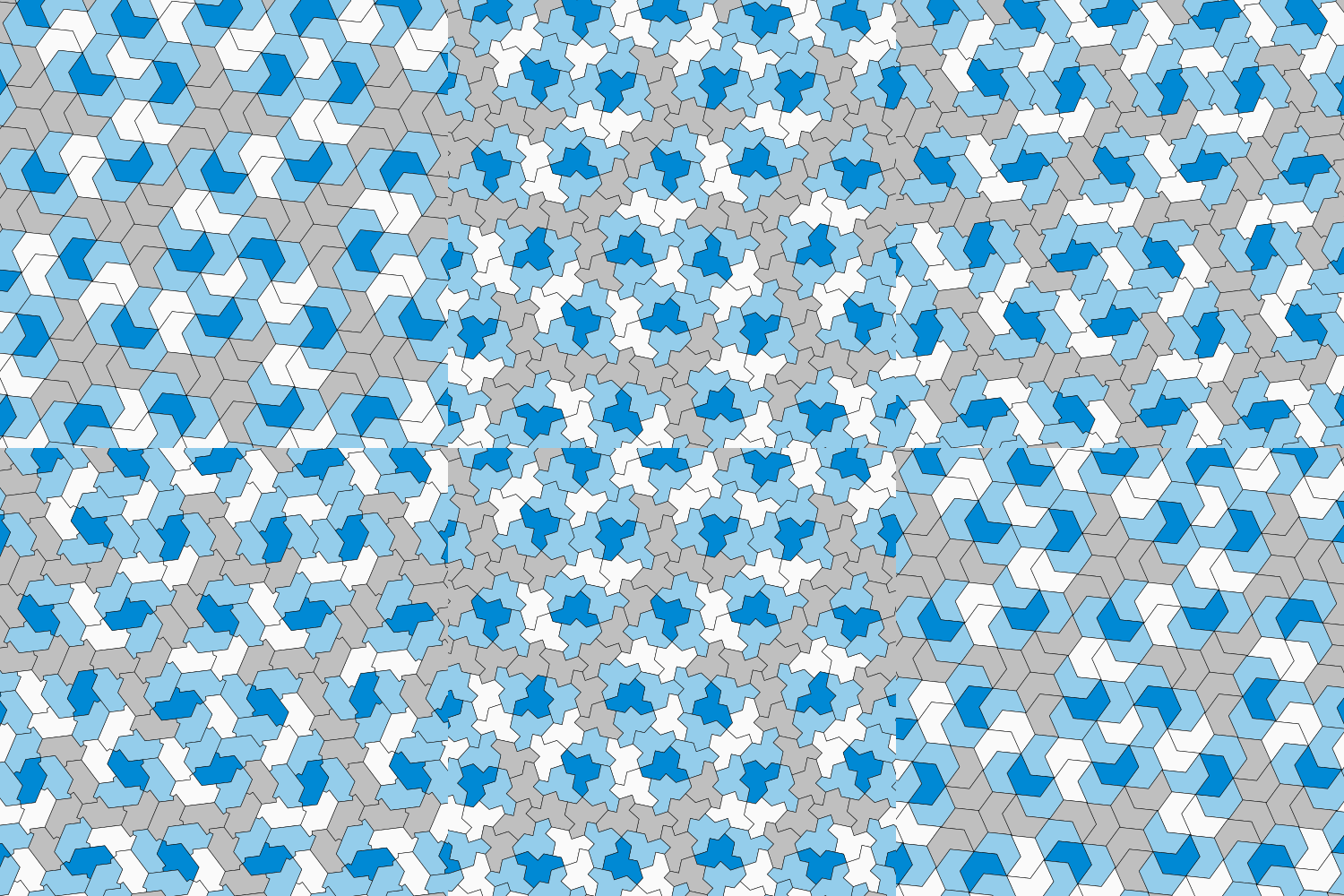
University of Waterloo
Hats may not be the only aperiodic monotile. According to the team, technically, this is part of a family of very similar shapes, with minor tweaks still following the same conventions.
“A more interesting question is whether there are radically different aperiodic monotiles,” Kaplan said. “My answer is that there is no reason to doubt otherwise, and there must be all other reasons to doubt.”
A study describing the new geometry is available on the preprint server ArXiv.
Source: University of Waterloo
