











Intel launched its Xeon line in 1998 and has dominated the world of professional workstations for the better part of the last 25 years. But a few years ago, AMD’s Threadripper came along and started to seriously take market share from the Xeon, with a massive jump in core count and frequency. Now Intel has fought back with his Sapphire Rapids and a new professional architecture called 4.th Gen Scalable Xeon and Xeon W-3400 series. Which of these new Xeons is right for you and what are the differences between them? Let’s compare the Scalable Xeons and the Xeon W series.
About Sapphire Rapids
Sapphire Rapids is the codename for Intel’s latest Xeon processors released in Q1 2023. They use the 10nm Golden Cove architecture, utilize the LGA 4677 socket and support the latest features like DDR5 ECC RAM and PCIe Gen 5.
Scalable Xeon – Who is it for?
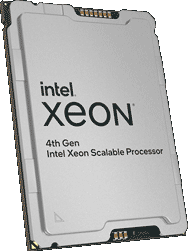 Scalable Xeon, specifically 4th The Gen with Sapphire Rapids architecture is Intel’s option for multicore server platforms and highly threaded workstations. The main advantage of this platform is that it is scalable. That means it supports dual CPU sockets and some skus support 4 sockets. This theoretically allows performance to scale up to 4 x 60 cores. However, the drawback of scalable Xeon is its high core count and scalability leads to a low base frequency, making it unsuitable for frequency-constrained applications such as CAD.
- Best for – Servers, highly threaded applications, dual socket workstations
- AMD Comp – Epyc
Xeon W Series – Who is it for?
Intel Xeon W processors are designed for professional workstations. It offers similar core counts to the Scalable Xeon, but with higher clocks and turbo speeds for demanding workflows that require both. There are two main varieties, the W-3400 and W-2400, both with similar feature sets, but the W-3400 is exclusively high end. However, none of the Xeon Ws are scalable, so there is only one socket.
- Best for – professional workstations, VFX, 3D CAD rendering, AI
- AMD – Threadripper
Feature comparison
| Xeon Scalable | W series | |
| architecture | sapphire rapids | sapphire rapids |
| max core | 60 (8490H) | 56 (W9-3495X) |
| turbo frequency | 4.2GHz (6416H) | 4.8GHz (W7-3455) |
| socket | LGA4677 | LGA4677 |
| chipset | C741 | W790 |
| Scalability | yes | no |
| RAM type | DDR5 | DDR5 |
| ECC support | yes | yes |
| RAM channel | 8 | 8 |
| Max PCIe Lanes (per CPU) | 80 | 112 |
| Max L3 cache | 112MB (8490H) | 105MB (W9-3495X) |
| Built-in Intel Accelerator | yes | yes |
Xeon vs i9
I’ve discussed the Xeon vs i7/i9 comparison in a previous post, but with the release of the 24-core i9-13900k and its 5.8GHz turbo speed, should I consider it for my next workstation? If it’s a thread (think AutoCAD and Revit) and you only need one GPU and no ECC RAM, then yes. But for multi-core rendering and long-term durability, Xeon is still ideal. See the post linked above for more information on why.
Scalable Xeon vs W Series – Which is Better?
Which Xeon is best depends on your workflow. If you’re looking for maximum total cores or designing a rendering server, Scalable Xeon is the way to go. However, if you need high speed combined with 24 or more core counts for maximum ROI, Xeon W is recommended. Start by configuring each of the options below.
Configuring Scalable Xeon HD360Max
Configuring the Xeon W-series HD150
question?Call our expert sales team for a no-obligation consultation at 804-419-0900

Josh has been with Velocity Micro since 2007, holding various marketing, PR, and sales-related roles. As Director of Sales & Marketing, he is responsible for all direct and retail sales as well as marketing activities. He enjoys reruns of Seinfeld, Atlanta He Braves, John, Paul, or Beatles songs written by George. I’m sorry, apple.
