











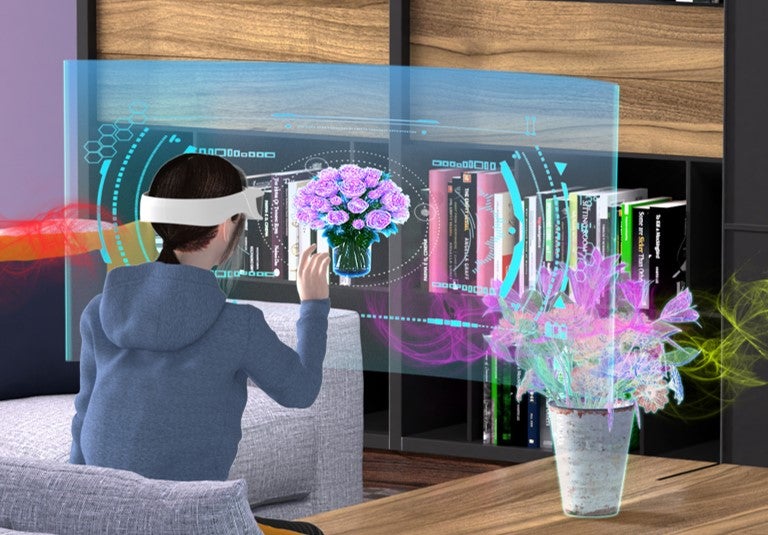
Virtual reality is already ubiquitous in entertainment and is beginning to spread across fields ranging from education to healthcare. But while visual and auditory interfaces have come a long way, and the sense of touch, or “haptics,” has improved, one of the key senses missing from virtual worlds is smell.
Maybe that is about to change. Engineer Xinge Yu and his colleagues at the City University of Hong Kong have developed a lightweight, flexible, wireless olfactory interface that can accurately deliver scents such as lavender, pineapple, and green tea to VR users, allowing them to be more fully immersed in scented virtual worlds. bottom. “When you bring smell into VR, it expands into another dimension,” Yu says. “We wanted to develop a wearable, skin-integrated format that people can take and use anywhere, anytime.”
The team’s design was described in a paper published Tuesday Nature CommunicationsThe main advantage is that you can control the intensity of the odor. In one of her demonstrations of the study, a four-dimensional movie increased the intensity of the smell produced when a woman held a rose close to her nose.
Previous olfactory interfaces typically used bottles of liquid perfume, atomizers (devices that turn the liquid into a fine mist), and some method of blowing away the atomized droplets. It works, but it is fixed, has a limited operating time between refills, and the intensity is not easy to control. These shortcomings made the device less practical in a VR system .
The new design uses small scent-infused paraffin wax pads that are heated by electrodes to release the scent. A temperature dependent resistor or thermistor senses temperature and controls the intensity of the odor. A magnetic induction coil also controls the metal plate to draw heat away from the electrode, cooling it quickly and blocking the scent. An array of these odor generators, millimeter in size, is built into a thin, flexible sheet of electronic equipment.
This study covers two different device formats. The first is small enough to stick to the user’s upper lip, but contains only two odor generators. The second is worn like a face mask and comes in nine. Different combinations can be blended with different intensities to create a palette of thousands of possible fragrances.
The proximity to the user’s nose and clever engineering allows for a mere 1.44 seconds delay between activation and receipt of the scent. The atomizer is faster, but the new device lacks control and is smaller than ever before, says Judith Amores, a senior researcher at Microsoft Research and a research affiliate at the Massachusetts Institute of Technology. An olfactory interface for health applications, but was not involved in research. “The advantage of this system is that it can be made even smaller,” she says. “That’s what’s exciting.”
This research includes demonstrations of possible applications as well as extensions of VR, such as odor-based message delivery and emotional evocation. Researchers suggest that the device could even be used to alleviate depressed mood and promote memory in people with age-related cognitive decline. “Scents are directly related to the emotional and memory parts of the brain, so they have many uses related to well-being and health,” says Amores. “It can also be used as a method of smell training to help people who have lost their sense of smell due to COVID.”
Researchers are already starting to scale things down even further. Their system is currently 2-3 times smaller and they aim to be 5-10 times smaller in the future. “That’s the next step,” says Yu.
