











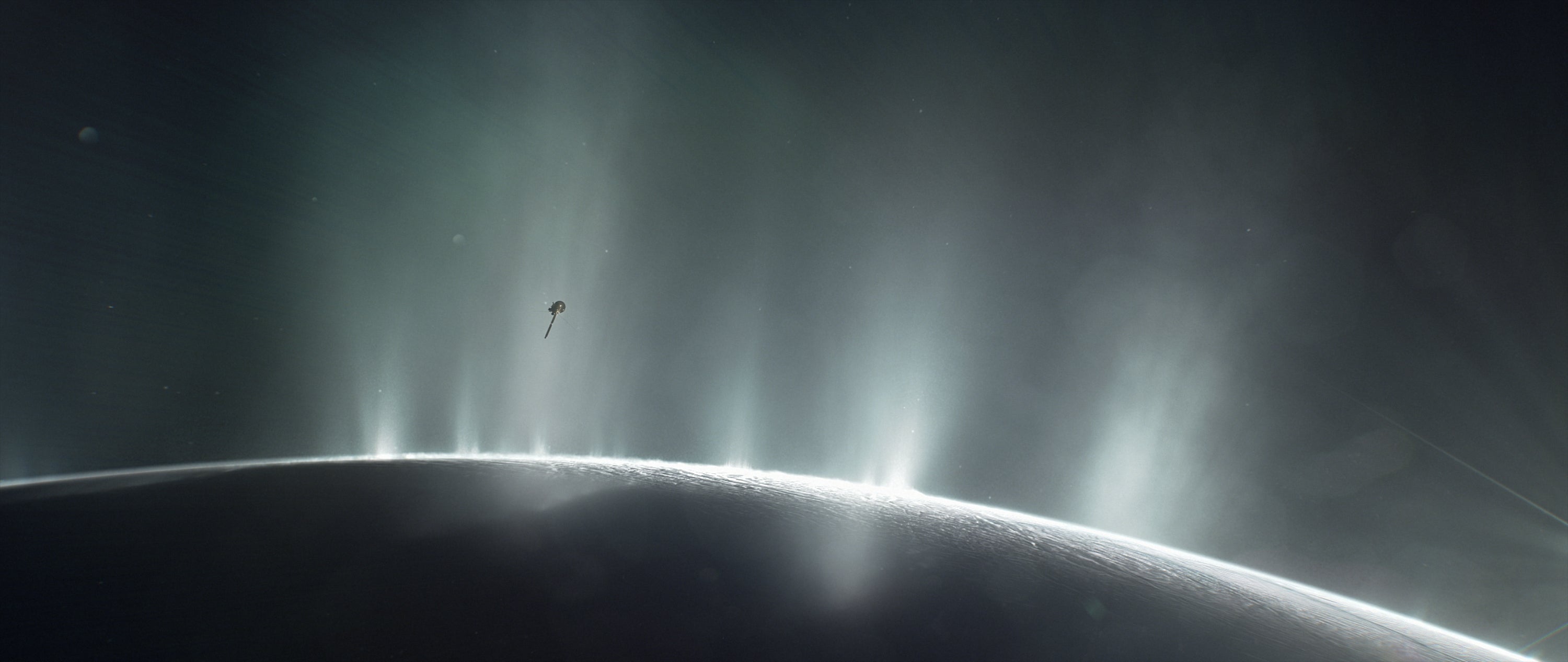
The James Webb Space Telescope (JWST) has discovered that Saturn’s moon Enceladus is spewing out a giant plume of water vapor, far larger than anything previously observed there. This gigantic cloud may contain the chemical components of life that have leaked from beneath the moon’s icy surface.
In 2005, NASA’s Cassini spacecraft found ice particles erupting from Enceladus’ subsurface ocean through cracks in the moon’s surface. But the JWST shows that matter is spraying into space much farther than previously thought—many times deeper than Enceladus itself.
“It’s immense,” planetary astronomer Sarah Fudge of NASA’s Goddard Space Flight Center in Greenbelt, Maryland, said on May 17 at a conference at the Space Telescope Science Institute in Baltimore, Maryland. She declined to provide further details, citing an upcoming scientific paper.
unusual sea world
Enceladus is exciting astrobiologists because it is one of the few “ocean worlds” in the solar system and one of the best places to look for extraterrestrial life. The saline ocean beneath Enceladus’ ice-covered outer layer could be a habitat for life, and could be maintained by the chemical energy of seafloor hydrothermal vents.
Material erupting from Enceladus, primarily through fissures known as tiger stripes around the moon’s south pole, are directly linked to its potential extraterrestrial ecosystem. The plume observed by Cassini contained silica particles that were probably transported from the ocean floor by fluid churning. Cassini flew through Enceladus’ plume many times, measuring ice grains and life-friendly chemicals such as methane, carbon dioxide and ammonia.
But it took the JWST telescope 1.5 million kilometers from Earth to discover what Cassini couldn’t see from his ringside seat. Cassini was able to find ice grains that didn’t move far from the surface, but JWST has a wider field of view and highly sensitive instruments that can capture the faint gas signals around Enceladus.
Overview of Enceladus
On November 9, 2022, JWST took a quick peek at Enceladus. Just four and a half minutes of data revealed a huge, very cold plume of water vapour. Future papers will quantify the amount of water ejected and its temperature, Fudge said. But plumes are less dense and likely resemble diffuse cold clouds rather than wet sprays. This is not good news for anyone hoping to sample and discover life in plumes, as signs of life can be too sparse to detect. The ice grains observed by Cassini, much closer to Enceladus, contain high concentrations of organic particles, said Shannon McKenzie, a planetary scientist at the Johns Hopkins University Applied Physics Laboratory in Laurel, Maryland. It is highly likely that there will be
JWST also analyzed the spectrum of sunlight reflected from Enceladus and found evidence of many chemicals, including water and possibly other compounds, that could suggest geological or biological activity in the lunar ocean. discovered. “There are many more surprises,” Fudge said.
The researchers are already planning ways to follow up on this finding. Last week, JWST organizers announced a list of observations to be made during the telescope’s second operation, including another project to study Enceladus. This study surveys Enceladus for six times the duration of the original JWST study and aims to find compounds associated with habitability, such as organic compounds and hydrogen peroxide. “These new observations represent the best way yet to find indicators of surface habitability,” said Christopher Glein, a geochemist and project leader at the Southwest Research Institute in San Antonio, Texas. They will provide it,” he said.
Snake robot scouting the moon
The JWST discovery provides further insight into NASA’s potential mission to search for signs of life on Enceladus. Proposals under consideration include an “Obilander” mission that will orbit the Moon and land in Antarctica over a period of 18 months. Another proposal calls for the development of autonomous snake robots that can explore the ocean while gliding under Enceladus’ ice.
Other icy moons of the solar system are also attracting the attention of JWST. At the conference, Goddard planetary scientist Jeronimo Villanueva reported that the telescope had detected carbon dioxide on Jupiter’s moon Europa. Scientists are excited because carbon and oxygen are important building blocks for life on Earth. Next year, NASA plans to launch a mission to Europe to study its sea world in more detail. “This is definitely a new era in solar system exploration,” said Villanueva.
This article is reproduced with permission and was first published on May 18, 2023.
