











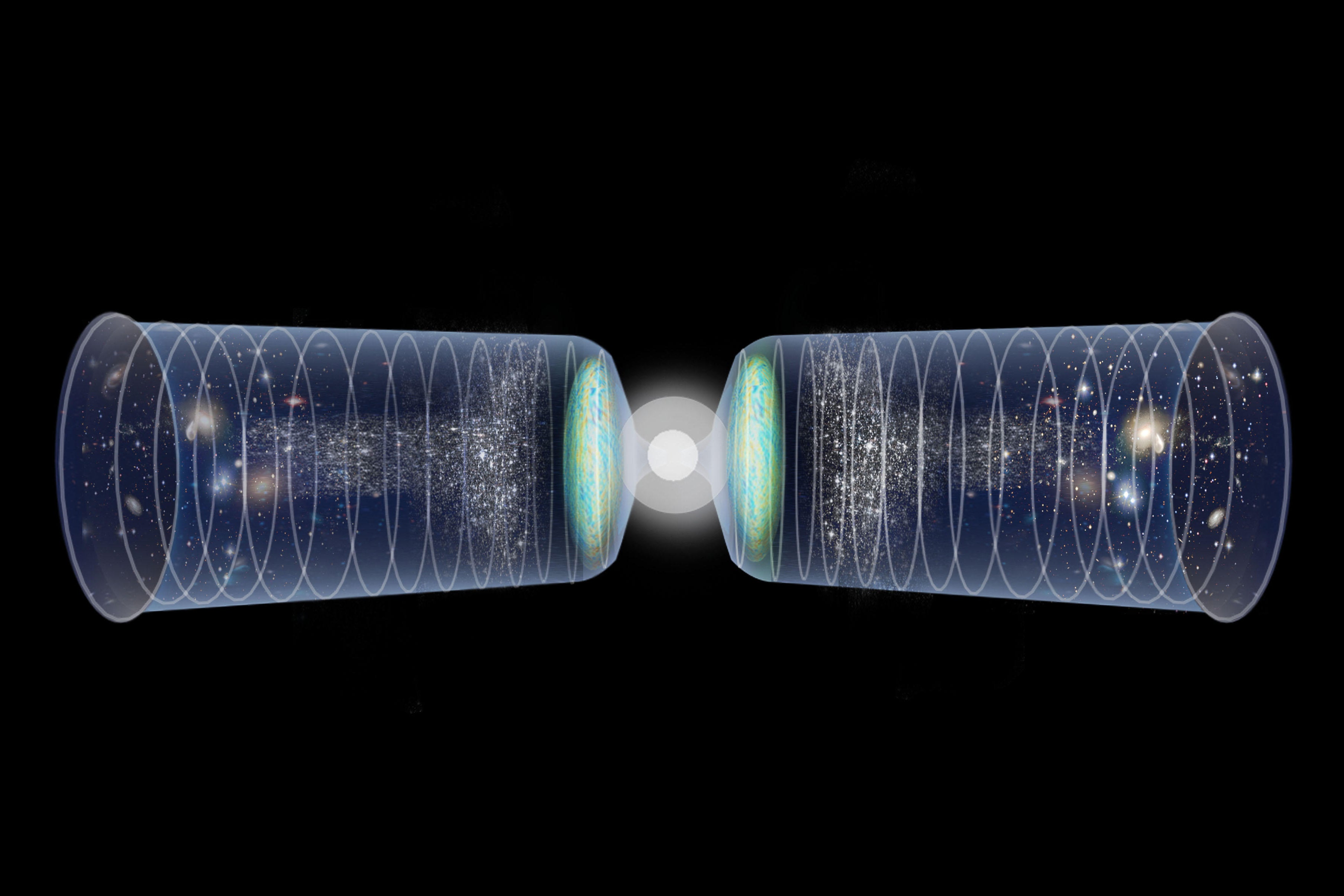
How did the universe begin? Did it start with the big bang, or was there a bounce?Does the universe evolve by expanding and collapsing forever?Now, in his two papers, the researchers explore different models of the so-called bouncing universe. It pierces, suggesting that the universe we see around us is probably a one-time proposition.
Proponents of the bouncing universe argue that our universe did not spontaneously emerge out of thin air. Rather, proponents argue, the former universe shrunk into itself and then regrown into the universe we live in. This could have happened just once, and by theory could have happened an infinite number of times.
So which scenario is correct? The most widely accepted explanation for the history of the universe is that it began with the Big Bang, followed by a period of rapid expansion known as cosmic inflation. According to this model, the glow left behind when the universe was hot and young, called the cosmic microwave background (CMB), should look roughly the same no matter which direction you look at it. However, data from the Planck Space Observatory, which mapped the CMB from 2009 to 2013, showed unexpected fluctuations in microwave radiation. They could be meaningless statistical fluctuations in the temperature of the universe, or they could be signs that something interesting is happening.
One possibility is that the CMB anomaly suggests that the universe did not arise out of thin air. Instead, it was born after the previous universe collapsed and bounced back, creating the space and time we live in today.
The bounce universe model can explain these CMB patterns, as well as persistent questions about the standard description of the origin and evolution of the universe. In particular, the big bang model of the universe begins at a singularity. A singularity is a point that emerges out of nothing and contains all the progenitors of the universe in a region so small that it is essentially of no size. The idea is that the universe grew from a singularity, went through inflation, and settled into the more slowly expanding universe we see today. But the singularity is a problem because physics and math itself doesn’t make sense when everything is packed into an infinitely small point. Many physicists prefer to avoid singularities.
One bounce model that avoids singularities and slightly mitigates CMB anomalies is known as loop quantum cosmology (LQC). It relies on a bridge between classical physics and quantum mechanics known as loop quantum gravity, which assumes that gravity decays over very short distances rather than increasing infinitely. “A cosmological model inspired by looping quantum gravity can solve some problems, especially the singularity problem,” said Ruth Dürer, a cosmologist at the University of Geneva. Dürer co-authored his first of two new studies on the bouncing universe. In it, she and her colleagues searched for astronomical signs of such models.
In the LQC model, the progenitor of our universe could have contracted due to gravity and become extremely compact. Quantum mechanics will eventually take over. Instead of collapsing to a singularity, as many cosmologists believe our universe did, it may have begun expanding again and even undergoing a phase of inflation.
If that happened, it would have left a mark in space, says physicist Ivan Agro of Louisiana State University. Agulo, who was not involved in either of the recent analyses, proposes that the mark will appear in a feature of the CMB data known as “bispectrum.” This is a measure of how different parts of the universe interacted in the bounce. scenario. The bispectrum is not evident in his CMB images, but it will be evident in his analysis of the ancient CMB microwave frequencies.
“If observed, this bispectrum would play a decisive role in determining the existence of a bounce rather than an impact,” Agro said. Agüro’s group previously calculated the bispectrum that emerges 400,000 years after him from a cosmic bounce. Dürer and his colleagues took the calculation further, but compared it to the current Planck-his CMB data, which showed no noticeable signs of a bispectral-his imprint.
Many other bouncing cosmos models may still be viable, but the lack of finding significant bispectra may rule out models that rely on LQC to address CMB anomalies. It means that there is For Aguro, who had high hopes of finding concrete evidence of a bouncing universe, this is a sad outcome. But cosmologist Paola Delgado, a candidate at Poland’s Jagiellonian University, who worked on a new analysis co-authored with Dürer, says he has one potential advantage. “I’ve been listening for a long time, [attempts to merge quantum physics and cosmology] We can’t test it,” Delgado said. “It’s really nice to see that some classes in the model still have some contact with the observations.”
The exclusion of LQC cosmic bounce signatures from the Planck data means that the CMB anomaly remains unexplained. However, there is still a bigger cosmic question: did the universe have a beginning in the first place? As far as Big Bang proponents are concerned, Big Bang did. But that leaves the inexplicable singularity that started it all.
Alternatively, according to the so-called cyclic cosmology theory, the universe is immortal and repeats infinite bounces. A bouncing universe can have one or more cycles, but a truly cyclical universe has no beginning and no end. It consists of a series of bounces that return for an infinite number of cycles and then continue for an infinite number of cycles. And since such a universe has no beginning, there is no big bang or singularity.
The work co-authored by Dürer and Delgado does not rule out an immortal periodic cosmology. Many theories explain such a bouncing universe in ways that are difficult or impossible to distinguish from the “big bang plus inflation” model by looking at the Planck CMB data.
But according to University of Buffalo physicist William Kinney, co-author of a second recent analysis, the idea of an ever-circulating universe is deeply flawed. That flaw is the entropy that accumulates as the universe bounces back. Entropy, which is often thought of as the amount of disorder in a system, is related to the amount of useful energy in the system. The higher the entropy, the less energy is available. As entropy and disorder increase with each bounce of the universe, the amount of available energy decreases each time. In that case, the universe would have had a larger amount of useful energy in its early days. Extrapolating back far enough, it would mean a big bang that begins with an infinitely small amount of entropy, even for a universe that experiences periodic bounces thereafter. (If you’re wondering why this scenario doesn’t violate the law of conservation of energy, what we’re talking about is Available energy. The total amount of energy in the universe remains static, but the amount available to do useful work decreases with increasing entropy. )
Kinney and one of his colleagues discovered that a new periodic model sidesteps this problem by requiring the universe to expand significantly with each period. The expansion smoothes out the universe and dissipates entropy before collapsing again. This explanation solves the entropy problem, but researchers calculate in a recent paper that the solution itself ensures that the universe is not immortal. “I feel like we’ve proven something fundamental about the universe,” Kinney says. “The universe probably had a beginning.” This means that at some point the Big Bang happened, even though that event happened many years before the universe bounced back, which meant that It suggests that a singularity was needed to make everything work.
Kinney’s paper is the latest in the debate over a cyclic universe, but proponents of a universe without beginning and end have yet to react in the scientific literature. Princeton University astrophysicist Paul Steinhardt and New York University’s Anna Ijas, two leading proponents of the cyclical universe, declined to comment for this article. But if the history of the debate is any indication, we may soon hear of a workaround to counter Kinney’s analysis.
Nelson Pinto Neto, a cosmologist at the Brazilian Physical Research Center, has studied bounces and other periodic models. I agree that Planck’s data likely rule out bounces under loop quantum cosmology, but I’m more optimistic about the periodic universe question. “Existence is a fact. We are all here now. Non-existence is an abstraction of the human mind,” says Nelson. “This is why I think [cyclic universe]What has always existed is simpler than what is created. But as a scientist, I have to accept both possibilities. ”
