











What’s the strangest real number you can imagine? Probably many people think of irrational numbers like pi (π) and Euler’s numbers. And indeed, such values can be considered “wild”. After all, their decimal representation is infinite and the digits never repeat. But even such ridiculous numbers, and all the rational numbers together, make up only a fraction of the real numbers, the numbers that appear along the number line. (Just to be clear, these numbers can be used for all sorts of familiar measurements like time, temperature, distance, etc.)
However, it turns out that if you happen to pick a number on the number line at random, you will almost certainly get an “uncomputable” number. There is no way to determine exactly such values.
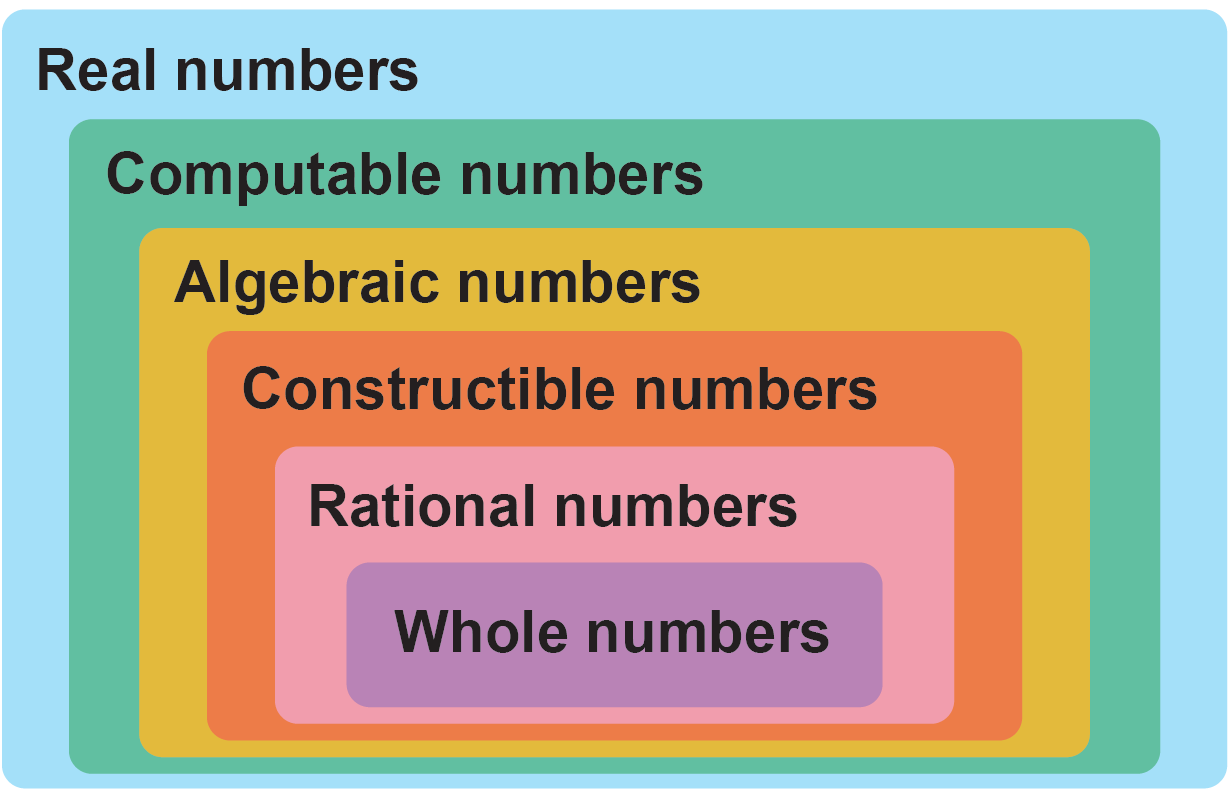
Real numbers consist of rational and irrational numbers. rational numbers (that is, numbers that can be written as fractions) p⁄qwhere p and q is an integer) includes natural numbers (0, 1, 2, 3, …) and integers (…, -2, -1, 0, 1, 2, …). The rest of the numbers on the number line are irrational. These too can be grouped into different categories, most of which we can’t even imagine.
It may not seem so surprising that infinity, infinitesimal, imaginary numbers, or other anomalous number spaces are difficult to explain. However, one might think that we now have a complete understanding of the real numbers that represent distances in our world. Unfortunately it’s not that simple. To understand this, we need to take a closer look at irrational numbers.
What are irrational numbers?
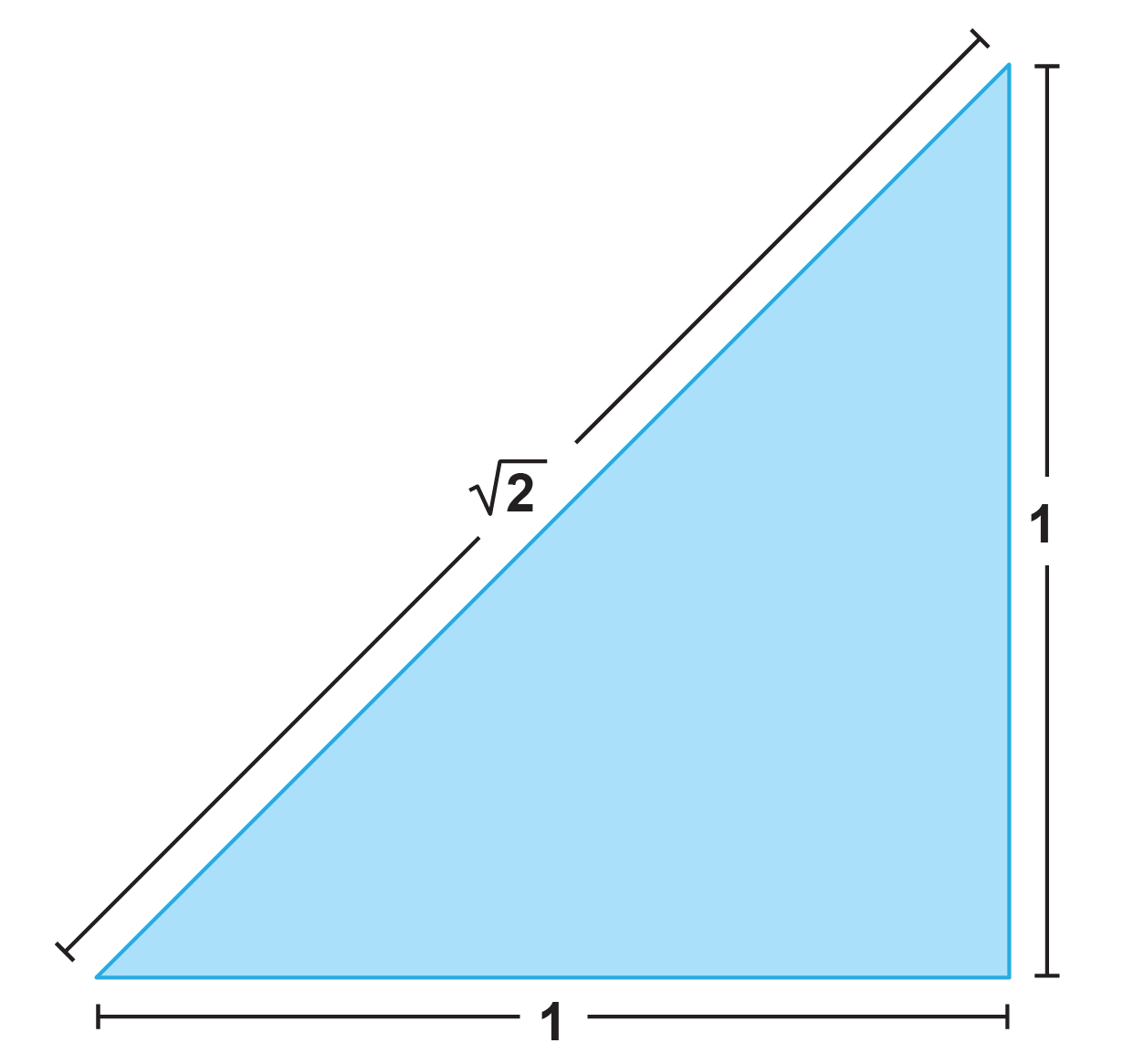
Any real number that cannot be represented by the fractional parts of two integers is irrational. (Note: integers are integers.) Irrational numbers include the square root of 2, for example. Its decimal representation is infinite without repeating. In fact, √2 is one of the simplest irrational numbers because it is configurable. That is, it can be generated using a compass and a ruler by drawing a right-angled triangle with two sides 1 unit in length. The length of the hypotenuse of the triangle is √2. In a similar fashion, the golden ratio φ can be constructed geometrically, like many other irrational values.
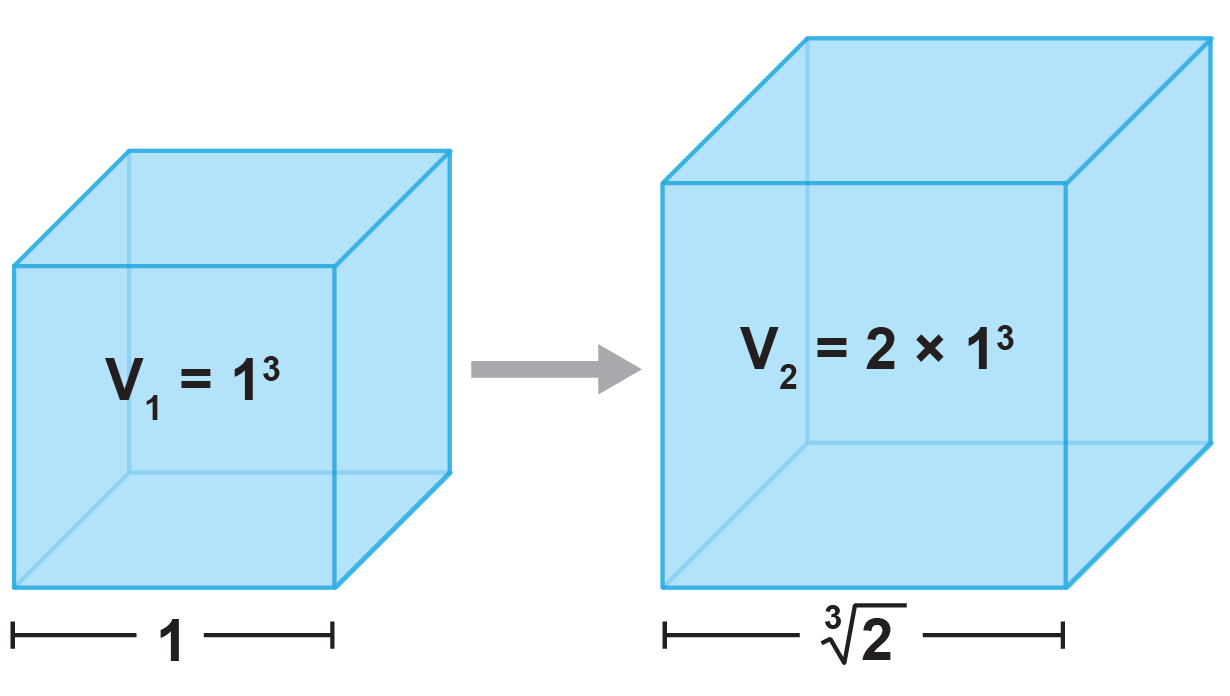
But even in ancient times, people encountered figures that could no longer be generated by such simple geometric methods. A famous example is the doubling of a cube. How can you turn a cube with side length 1 into a cube with twice the volume? As the mathematician Pierre Wanzel discovered in his 1837, the required side length ∛2 for this new cube cannot be created using a compass and ruler. But ∛2 belongs to algebraic numbers and can be written as a solution of a polynomial equation. For ∛2, the corresponding equation is X3 = 2.
Some numbers are transcendental
Some transcendental numbers cannot be expressed as solutions to such equations. That is, there is no simple formula that can calculate them. Famously, π falls into this category. But that doesn’t mean we don’t know its value. The Greek mathematician Archimedes discovered a computational rule that determined π at least approximately. In addition, there are many algorithms that arbitrarily spit out 587 million decimal places of pi. Given enough computational power and time, numbers can, at least in theory, be determined to arbitrary precision. The same applies to the Euler number (e), or 2√2.
Transcendental numbers have some mysteries. There are clear ways to determine whether a number is configurable, but by contrast it is difficult to prove whether a value is transcendental. For example, in 1934 Soviet mathematician Alexander Gelfond was able to prove composite numbers. ePi Transcendental.But if the value π ise or π x e or pi – e Whether it is algebraic or transcendental is still not clear today.
Incomputable numbers are even stranger
Until the early 20th century, people thought that transcendental numbers were the wildest real numbers had. But I was wrong. In 1937, British mathematician Alan Turing published a paper on computable numbers. He used the term to describe any value for which there are computational rules (that is, algorithms) that a computer can follow to compute a number with arbitrary precision.
Nearly all known transcendental numbers such as π and picture, fit into this category. After all, we know at least an approximate number, and we also know how to calculate it. However, as Turing showed in his writings, there are equally uncomputable numbers whose values cannot be approximated to arbitrary precision. I mean, I don’t know what they are like.
Worse, almost all real numbers are not computable.
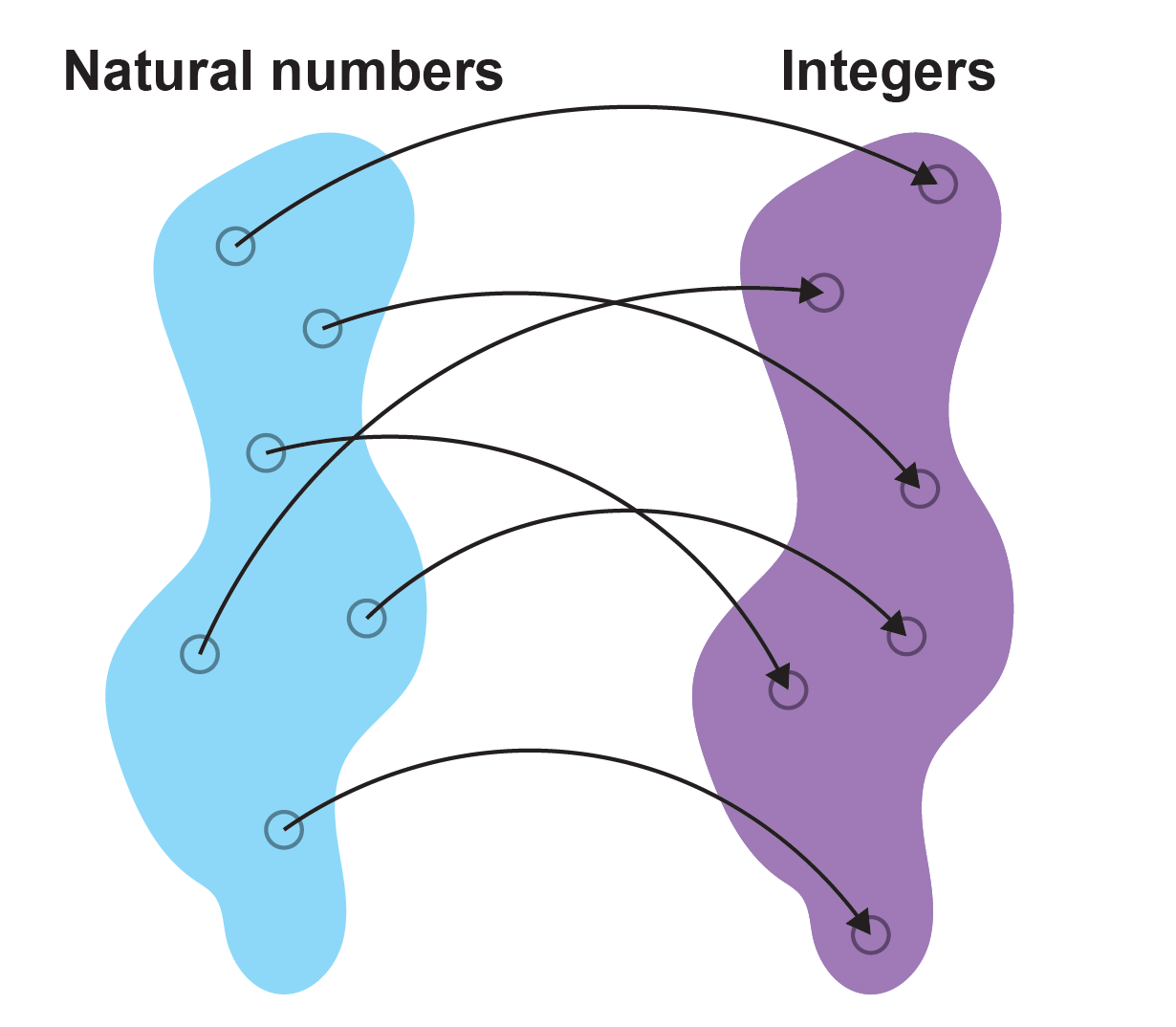
Given the infinite size of the various sets of numbers, we see this. The mathematician Georg his Cantor laid the foundation for this idea at the end of the 19th century. Then he was able to show, for example, that the sets of natural numbers, integers and rational numbers have the same cardinality (the mathematical expression for the size of the set). Why? To understand, the first thing to note is that the same rules of thumb for finite numbers do not apply to infinity. For example, consider natural numbers and integers. (0, 0), (1, –1), (2, 1), (3, -2), (4, 2), etc. Since natural numbers have no end, he found a one-to-one mapping between the two sets. This is like assigning each person a seat on the bus at a bus stop and vice versa. In this case, we know that the bus has as many seats as there are people at the bus stop. The same is true for natural numbers and integers.
A similar one-to-one mapping can be seen between rational and natural numbers. As Cantor was able to prove, the base of the natural numbers is the smallest possible infinity. He called it “countable infinity”.
Real numbers, on the other hand, cannot be counted. Cantor was able to prove that the cardinality of the real numbers is necessarily greater than that of the natural numbers. He did this by demonstrating that there is no way to enumerate all real numbers in a list (no matter how long) without omitting some values. Therefore, the real numbers form an uncountable set.
Cantor’s reasoning is as follows. Suppose we have a list of all real numbers. Then you can imagine this list as a table. Each row has a number and each column shows the decimal places. Cantor proposed that if we draw a circle around the set of numbers that form the diagonal of this table (the first digit in the first row, his second digit in the second row, etc.), adding 1 will give us a new real number We have demonstrated that we can create at each slanted entrance. This new number cannot be included in the list. So the original list of all real numbers is incomplete.
But as Turing said, all computable numbers must be countable. For each of these numbers, we can develop a machine that simply calculates that value. These calculators can be numbered, so computable numbers are necessarily countable. This leads to the fact that uncomputable numbers make up the vast majority of real numbers. There are countless of them.
Therefore, calculating the probability of what kind of real number will appear if we randomly draw a real number gives an obvious result. At 100%, this number is not computable. But that doesn’t mean you can’t draw other numbers. For an infinite set of events, zero probability does not mean that the outcome is impossible.
Given that many of these numbers are unknown, the fact that uncomputable numbers are so abundant is even more surprising.
The Halting Problem as Inspiration
The few existing examples of uncomputable numbers were defined by the famous stopping problem in computer science. To think about this Turing-invented problem, imagine a computer executing a particular set of instructions to solve a problem (that is, the computer uses an algorithm). The Halting Problem asks you to imagine a machine that can decide whether the computer running a particular algorithm will stop at some point or continue forever. As Turing proved, such a machine can determine if some algorithm can be executed in finite time, but clearly there is no way it can do this. all Possible program code.The Halting Problem is a direct application of the mathematician’s method Kurt Gödel Incompleteness Theoremstates that not all mathematical statements are provable.
The halting problem was used by Argentinian-American mathematician Gregory Chaitin to define uncomputable numbers. The so-called Chaitin constant Ω corresponds to the probability that a theoretical model of a computer (Turing machine) will stop for a given input: Ω = –∑p1/2|p|where p | indicates all programs that stop after a finite execution time.p| Represents the length of the program in bits.
Therefore, to calculate the Chaitin constant accurately, we need to know which programs will and will not, which is not possible according to the Halting Problem. Nevertheless, in 2000 mathematician Christian S. Carrode and his colleagues succeeded in calculating the first digit of the Chaitin constant, 0.0157499939956247687….
This means that if you randomly generated a program in the language used by Calude and his colleagues, it would hold true about 1.58% of the time within a finite run time. Chaitin constants cannot be computed to arbitrary precision, even if the result is highly precise.
Incalculable numbers and busy beavers
Another uncomputable number is the “busy beaver function”, or BB(n). This function computes the maximum output (measured in bits) that the algorithm can produce. n bit.
For example, the uncomputable number comes from the structure:n1/2BB(n). So far we only know his first four values in the busy beaver function. At least two other values can be estimated.
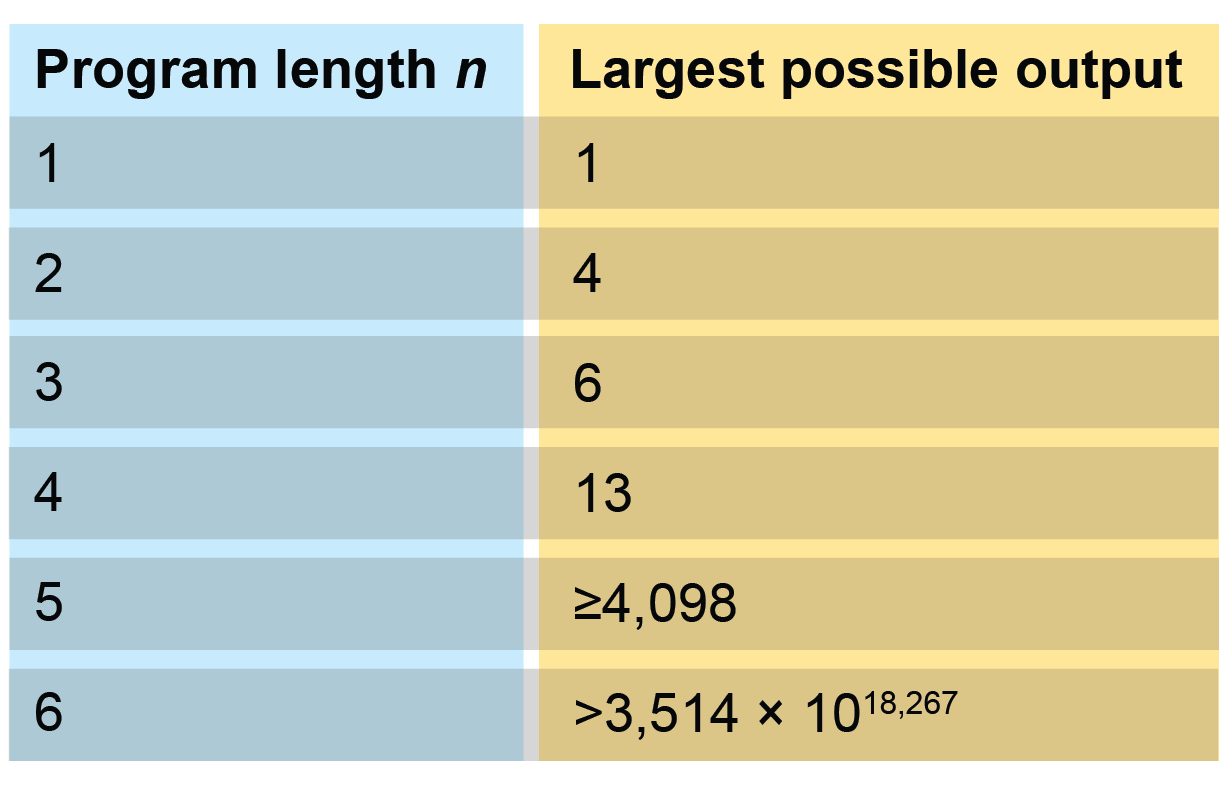
So the first digit of this uncomputable number is ∑.n1/2BB(n) = 0.51562548….
There are other complex ways to define non-computable numbers. Variations may also be considered. Still, given the abundance of computable numbers as we know them, it’s always surprising that uncomputable values dominate real numbers and, by extension, our world.
This article was originally published on science spectrum Reprinted with permission.
