











“Shanahan’s vice-presidential candidacy is an opportunity to bring to national attention the crisis in intellectual property rights. That is unlikely given her documented ownership of hundreds of millions of dollars of Alphabet stock (Class B shares, says Forbes).”
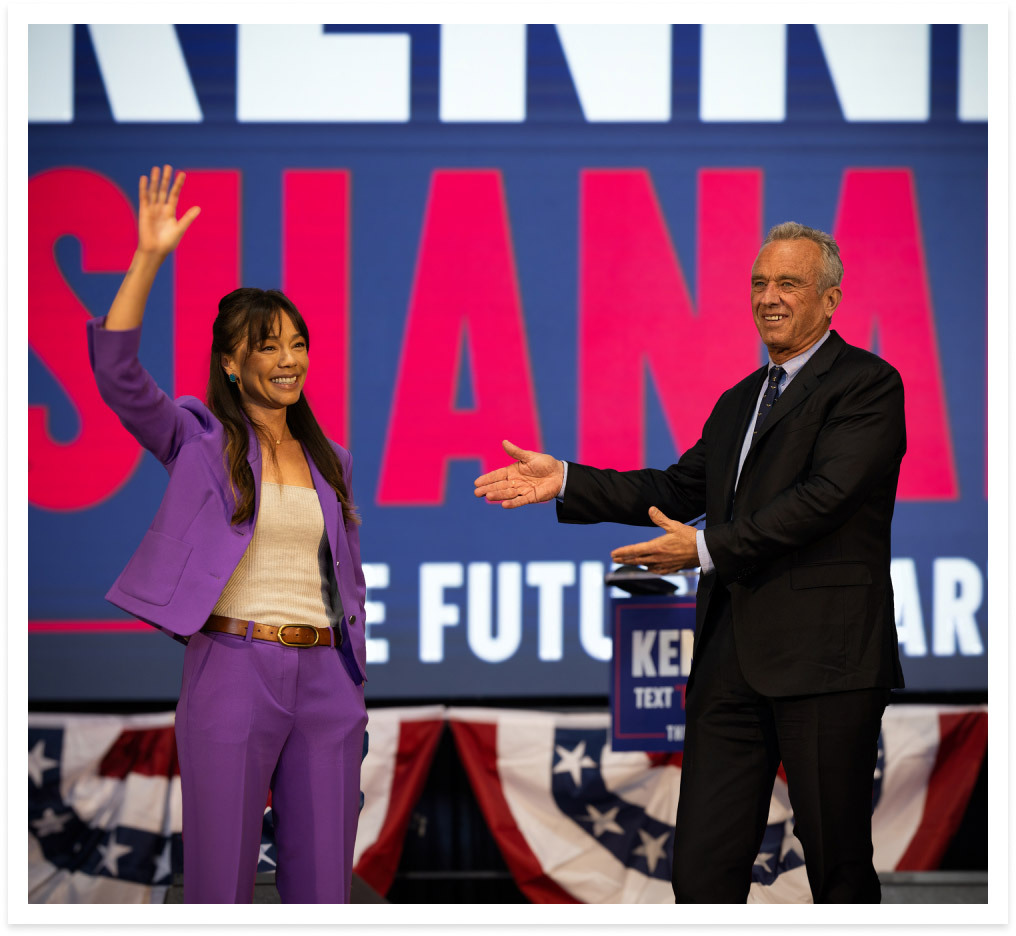
 Independent Presidential candidate Robert F. Kennedy, Jr’s Vice-Presidential running mate, Nicole Shanahan, a mercurial patent analyst, intellectual property lawyer and incidentally rich entrepreneur, is in the position to influence declining patent reliability and increasing copyright abuse. But will she?
This column is not intended to opine on Shanahan’s merits as an independent Vice-Presidential candidate, but to attempt to understand her motivation for running and its potential impact on IP rights, creators and assignees.
It is well-known that Shanahan was married for four years to Google founder Sergey Brin, before officially divorcing in 2022. She gave birth to their daughter in 2019 and their divorce separation, according to Forbes, left her with at least $400 million in Alphabet stock (2.6 million shares). Others speculate her post-divorce net worth could be more than $1 billion. Brin is currently the 10th richest person in the world, according to Bloomberg News and Forbes, with a net worth of $119 billion. According to financial disclosure documents over a three-year period, as reported in Wikipedia, Shanahan’s Bia-Echo Foundation’s sole donor was Sergey Brin. In 2020, Brin donated at least $23 million in shares of Alphabet. Since then, Shanahan has pledged $100 million.
Shanahan was said to have paid for the controversial Super Bowl ad for Kennedy that drew on his ties to his famous uncle, President John F. Kennedy, and father, Attorney General Robert Kennedy. The Kennedy family was not pleased.
More to the point, Shanahan worked as an analyst for RPX, the defensive patent aggregator, and was a research assistant for Colleen Chien, a known patent skeptic who coined the term patent assertion entity (PAE) and worked in the Obama administration. Chien formerly taught law at Santa Clara and has since joined the UC Berkeley Law School faculty.
 Shanahan founded ClearAccess IP in Palo Alto in 2013, a financial technology company that provides a platform for financial valuations, analytics, and competitive intelligence for patents.
Her vice-presidential candidacy is an opportunity to bring to national attention to the crisis in intellectual property rights – but will it?
ClearAccess IP was acquired for an undisclosed sum in 2020 by Erich Spangenberg’s IPwe, an integrated patent management company “using AI to help the creators and owners of IP assets effectively develop, manage and transact patent-protected technology.”
IPwe initially partnered with IBM, but on March 5 filed for Chapter 7 liquidation. Spangenberg, who was regarded as successful but aggressive patent enforcer in the 1990s and 2000s, had the right idea for his for his IP-transacting block chain platform, but could not deliver on the promise without additional capital. It is unclear what IPwe paid for ClearAccess IP or if it has retained any asset value for creditors.
Shanahan’s split from Brin was reported in the Wall Street Journal as the result of a supposed fling with Elon Musk, which she vehemently denies. Shanahan is married to her third husband, Jacob Strumwasser, who currently serves as the vice president at Lightning Labs, which develops software that powers the Lightning Network for Bitcoin. She describes him, per People, as a former Wall Street Guy whom she met last year at the Burning Man Festival.
The Kennedy Ethos
What is a patent analyst, IP lawyer, entrepreneur and ex-wife of Sergey Brin doing running with the independent candidate and potential Biden reelection spoiler?
Kennedy is a known anti-vaccination proponent, health policy skeptic and avid environmentalist. He has flirted with running as a Libertarian candidate. He has also dismissed the severity of the January 6 attack on the United States Capitol that left five dead and 174 police injured.
It is unclear if his beliefs are merely anti-establishment or extend to IP rights abuses. Some libertarians identify positively with the level-the-playing field exclusivity provided by some patents and copyrights, in theory a resource for independent inventors and creators. Others view IP rights as more government interference in the lives of businesses and people.
In terms of her motivation for running, Shanahan has stated that her daughter is on the autism spectrum and reports have indicated that Kennedy’s anti-vax position may appeal to her because of the frequently debunked junk-science linking autism with childhood vaccines.
There are far richer players with political aspirations that Kennedy might have called on. Shanahan is a Silicon Valley lawyer, an IP analyst and an academic fellow at CodeX, but a questionably successful tech entrepreneur. Her value to the ticket could be enhanced by her visible commitment to IP rights. Getting Kennedy and his followers to listen, I am afraid, will not be easy. The Biden administration’s misdirected pursuit of patent march-in rights is just the kind of issue on which she can score points and show her depth.
Shanahan’s vice-presidential candidacy is an opportunity to bring to national attention the crisis in intellectual property rights. That is unlikely given her documented ownership of hundreds of millions of dollars of Alphabet stock (Class B shares, says Forbes—a Class B share is a designation for a share class of a common or preferred stock that typically has strengthened voting rights or other benefits).
Shanahan is well-equipped to discuss the increasing lack of patent certainty since passage of the America Invents Act in 2011; the danger to SMEs and inventors by serial infringers; and the threat to innovation and creative expression caused by generative AI and other businesses, like ChatGPT and Bard (now Gemini), that relegate the content of their datasets to fair use when they should be paying for them and can well afford to. .
Reform Party VP candidate Pat Choate, who ran with Ross Perot in 1996 was an avowedly pro-patent economist, wrote a book titled, “Hot Properties: The Stealing of Ideas in the Age of Globalization.” It remains one of the clearer explanations about the foreign and domestic threat to IP rights and its impact. Perot and Choate garnered 8.4% of the popular vote.
Steppingstone?
The VP race may be an opportunity for Shanahan, who could eventually run locally in the Bay Area for Congress or for a state office. In tech-heavy California, companies like Google, Apple and Meta, liberal on social issues but more circumspect regarding IP ownership, can influence who gets elected. These and other IP-intensive businesses may wish to put their money on a candidate whose first-hand familiarity with IP rights can help assure their leadership.
