











POISED, as described by ADB and the Government of Maldives, “is installing energy management and control systems; energy storage; and improvements in distribution networks, in order to significantly reduce the need for diesel to generate electricity.”
The initiative involves deploying solar and diesel hybrid grid equipment across approximately 160 islands. It will transition islands from inefficient diesel-only power generation to hybrid systems combining renewable energy with diesel, aiming to decrease electricity costs, reduce emissions, and lower government subsidy requirements.
The recently announced microgrid is intended to reduce Himandhoo Island’s dependence on imported diesel fuel for electricity generation. The flow battery will provide energy storage to support power supply reliability during extreme weather events or periods of fluctuating energy demand.
Atri Energy Transition, which led Quino Energy’s Series A funding round in October 2025, will collaborate on manufacturing the proprietary organic electrolyte in Pune, India. Atri will also provide operations and maintenance support for the battery system for at least five years following commissioning.
Chinese redox blow battery manufacturer Suqian Time Energy Storage will supply the flow battery hardware for the project.
Eugene Beh, CEO and cofounder of Quino Energy, stated that the project represents the first commercial deployment of the company’s organic flow battery technology, in addition to previously announced government-supported projects.
In April 2025, Quino Energy and developer Long Hill Energy Partners were awarded US$10 million in grant funding by the California Energy Commission (CEC) to support an 8MWh flow battery energy storage system (BESS) project in Lancaster, California, US.
At that time, Quino noted the project as the first commercial deployment of its organic flow battery technology in the US.
S. Kishore, founder of Atri Energy Transition, described the Tencent CarbonX selection as an endorsement of organic electrolyte chemistry and noted the company’s participation in scaling the technology from pilot to commercial deployment.
Over the past 18 months, Quino Energy highlighted its completion of several financing and partnership milestones.
The company closed its Series A funding round led by Atri Energy Transition, the previously mentioned grant from the CEC, and secured US$5 million in funding from the US Department of Energy’s (DOE) Critical Facility Energy Resilience (CiFER) programme to support a 5MWh flow battery deployment in Southern California.
Quino also signed a Joint Development Agreement (JDA) with Jena Flow Batteries, whose parent company is Suqian Time Energy Systems.
OATI announces strategic partnership with The Paskenta Band of Nomlaki Indians
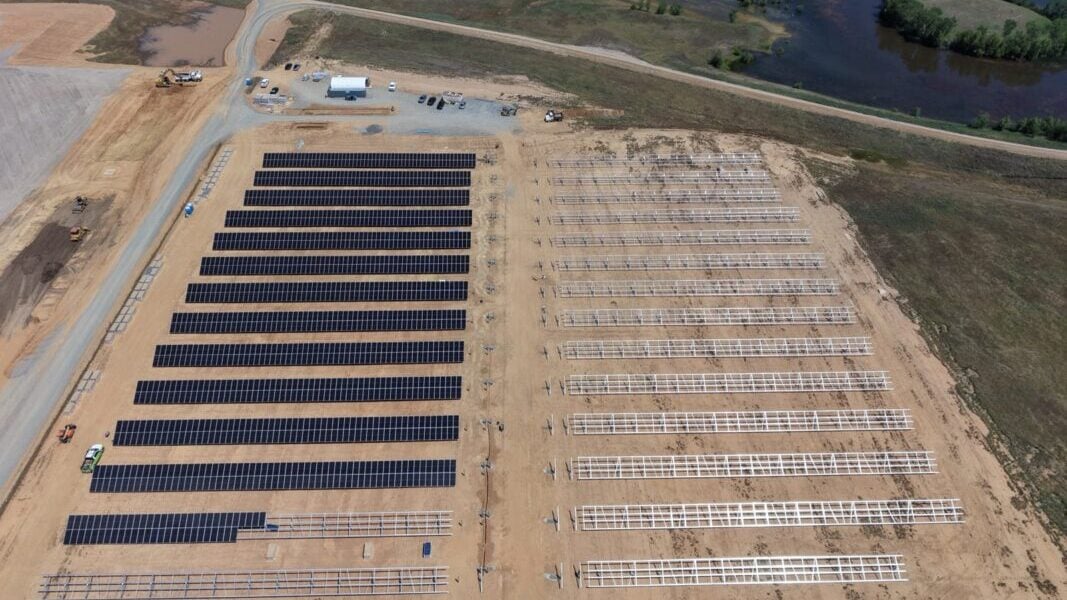
The Paskenta Band of Nomlaki Indians has partnered with Open Access Technology International (OATI) to integrate advanced microgrid controls into a two-part solar and BESS project in Northern California.
Announced 16 June, the project is designed to enable the tribal community to operate independently of the local utility grid during outages and periods of grid instability.
The project, which began construction in 2024, combines 4.5MW of solar PV generation with 21MWh of BESS across two microgrid sites.
Notably, the system features a dual-battery configuration that pairs lithium-ion (Li-ion) batteries with long-duration energy storage (LDES) technology from zinc hybrid cathode battery and storage system maker Eos Energy Enterprises to provide both rapid response capabilities and extended backup power coverage.
The microgrid addresses multiple challenges facing the tribal community, including electricity cost volatility, aging regional infrastructure, and heightened wildfire risks in Tehama County.
Damon Safranek, CEO of the Paskenta Band of Nomlaki Indians and Paskenta Enterprises, explained to Energy-Storage.news that energy cost instability makes long-term planning for job creation, housing, and community investment difficult.
“It’s not just cost, it’s volatility of cost,” Safranek explained. “If we don’t have visibility into what this core expense is going to be to the economy, then that makes it really difficult to invest into long-term projects.”
The tribe’s location at the northern edge of the Sacramento River Valley, surrounded by mountains on three sides, positions it as a critical point of refuge during regional emergencies.
During the 2018 wildfires that caused significant loss of structures and life in communities to the north and east, Paskenta served as a deployment hub for Cal OES and FEMA resources.
“If we’re going to be a point of emergency response, we need to make sure that all of our infrastructure is hardened and secure,” Safranek said.
Dual-battery technology approach
The project employs a hybrid battery storage strategy that combines different technologies to optimise performance across multiple use cases.
Jacob Schueller, partner and development executive at tribal energy developer Woven Energy, explained that the Li-ion battery provides rapid response capabilities and power quality benefits, enabling the system to island from the grid.
The Eos LDES system meanwhile serves as a deep charge resource for extended coverage during grid outages or when operating independently for cost management purposes.
The Li-ion system is provided by Elm. Schueller noted that Eos was selected in part due to domestic manufacturing capabilities during a period of supply chain instability, as well as superior round-trip efficiency (RTE) compared to other flow battery technologies.
“When you’re looking to get the most usable capacity-per-dollar, that RTE is very important,” Schueller said. The solar modules are manufactured by Heliene, a domestic manufacturer.
The project is supported by a FEMA Building Resilient Infrastructure and Communities (BRIC) grant, secured through a competitive process based on the tribe’s disaster relief experience in 2018 and the microgrid’s potential to provide resilience during future disasters. According to the companies, the project represents one of the largest state-funded microgrid initiatives.
OATI was selected through a competitive procurement process to provide microgrid controls engineering and technology.
David Heim, vice president and chief strategy officer at OATI, stated that the company is serving as the microgrid controls engineer and technology provider, responsible for controls design, sequence drafting, and implementing the control system that will manage both energy storage assets and serve the load under various conditions and contingencies.
“We’re bringing years and years and years of production field experience in managing mission-critical microgrids similar to this one,” Heim said, noting that OATI has developed its controller over time in conjunction with utility customers and partners.
OATI’s microgrid and distributed energy resource controller, GridMind will enable the two microgrid sites to operate together or independently, with tribal leaders intending to use the system as a foundation for establishing an independent, tribal-owned utility.
Schueller emphasised the importance of selecting a technology-agnostic controls provider to ensure flexibility for future operations.
Regional context and long-term planning
Regional factors contributing to electricity cost volatility in California include aging infrastructure, unprecedented demand growth, and wildfire-related risks.
Pacific Gas and Electric Company (PG&E), the utility providing electricity in the northern two-thirds of California, is working to underground power lines and build microgrids, with associated costs typically passed through to ratepayers.
Safranek emphasised that tribal governments carry the same responsibilities as other governments to ensure public housing, health, and safety.
“With that level of responsibility, it’s critical to have a grid infrastructure that’s resilient in times of chaos and crisis,” he said. “The tribe having control of the grid and its infrastructure allows for us to manage the risks that are posed from negative externalities.”
The project is designed to support critical community loads while reducing peak energy demand and costs, with the goal of providing visibility into long-term energy expenses to enable 20-year planning horizons for tribal investments.
The Paskenta Band of Nomlaki Indians is a federally recognised sovereign nation based in the Corning area of Northern California. The tribe operates several businesses within Tehama County, employing nearly 1,000 people in the local community.
Tribal enterprises include Rolling Hills Clinic, Tepa Companies, Paskenta Mad River Brewing, and Rolling Hills Casino & Resort.
